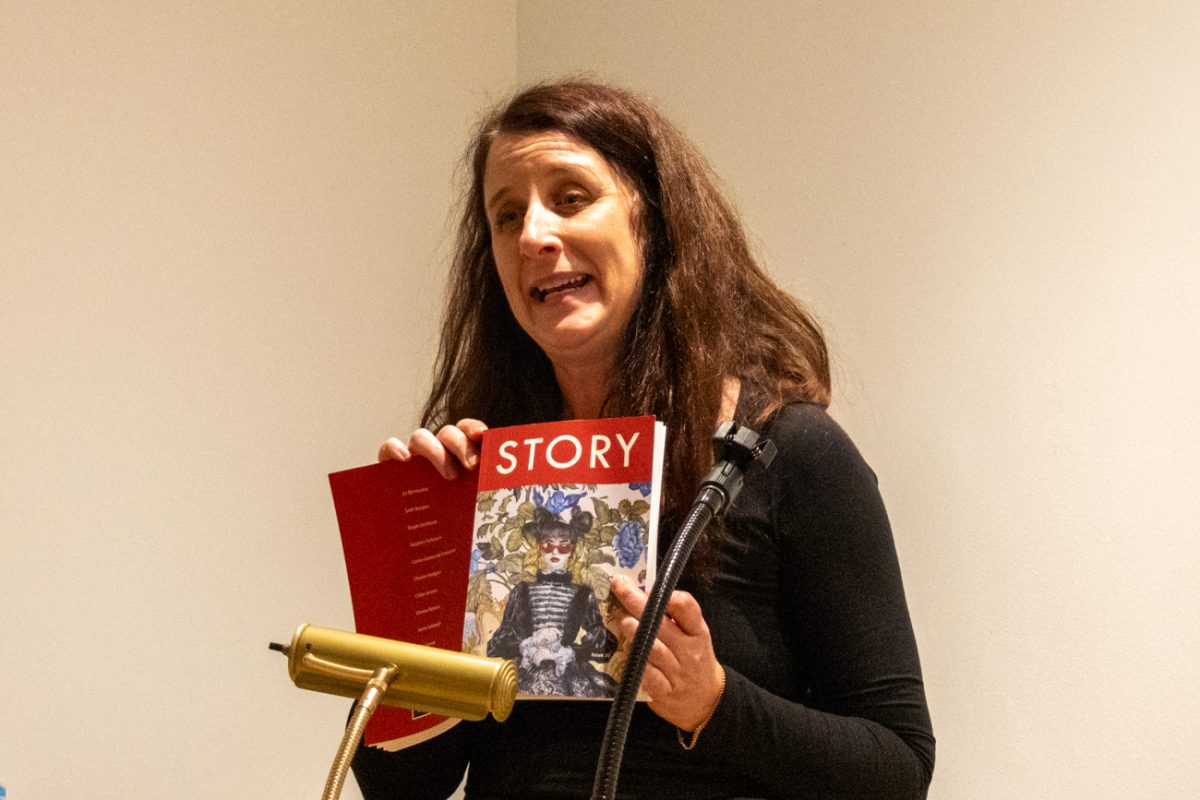
Wichita State’s fall installment of the Writing Reading Now series welcomed novelist and short story writer Christy Hodgen Nov. 11 for her first public reading in more than a decade.
The event was part of the “Words by Women” series, hosted by the English department and Women’s, Gender and Sexuality Studies Program.
The event, held in the Ulrich Museum of Art’s Dr. Same and Jacque Collection Study Center, featured a reading from Hodgen’s work followed by a discussion about writing, teaching and finding meaning in small, ordinary moments.
Margaret Dawe, director of WSU’s creative writing program, introduced Hodgen with high praise for her 2010 novel “Elegies for the Brokenhearted.”
Dawe highlighted Hodgen’s ability to write about ordinary lives with “deadpan humor and sentences that gorgeously evoke longing and admiration.”
“Some mornings, I make my tea and ask myself, ‘Read what Trump did yesterday or read more of Christy Hodgen’s ‘Elegies for the Brokenhearted?’” Dawe said. “‘Elegies’ wins.”
Dawe also described Hodgen as “Jane Eyre for now,” capturing how her fiction brings depth and dignity to characters who quietly persist through life’s disappointments.
Hodgen, who teaches at the University of Missouri-Kansas City, said it had been years since she last gave a public reading.
“It’s been so long since I’ve given a reading — maybe fifteen years — that I’d forgotten what it feels like to actually connect with people on the other end of this work,” Hodgen said.
Her reading featured a 10,000-word short story titled “Wish Strike,” which follows a group of friends with various degrees who work in retail together. It is the brink of Y2K and through their sarcastic manager, Ray, and their own frustrations, the story examines work, purpose and the quiet dignity of persistence.
“When I write, I’m usually circling the same question: what does a good life look like if no one’s clapping for you?” Hodgen said. “There’s so much talk about purpose and productivity, but I’m more interested in endurance, in people who keep showing up for small, unglamorous things.”
Her remarks often returned to the quiet resilience of ordinary people, a common connection that runs through much of her fiction. Throughout the evening, Hodgen reflected on the empathy that drives her writing.
Hodgen described her writing routine as one of discipline and solitude.
“Someone asked about my routine … I get up at 4:30 in the morning and write for two hours,” she said. “It’s dark and cold.”
Those hours, she said, are when her thoughts are clearest — when she can fully inhabit her characters and reflect on the “quiet resilience” that threads through much of her work.
“I think fiction, at its best, is a kind of mercy,” she said. “It lets us see the parts of each other we’d otherwise overlook.”
Hodgen’s comments offered an introspective look into her creative process and her evolving perspective as both a writer and a teacher. She noted how her approach to writing has changed over time.
“Getting older has made me less afraid of sentiment and more afraid of irony,” Hodgen said. “When I was young, I thought writing was about being brilliant. Now I think it’s about being kind.”
Dawe said Hodgen’s appearance fit the “Words by Women” series’ mission to spotlight women authors whose work engages with themes of identity, place and endurance.
“I’m grateful she’s driven across the Flint Hills this November day,” Dawe said.
For Hodgen’s, that literal and creative journey remains rooted in persistence.
Hodgen said, “If you keep doing the work, even in the dark, the work will remember you.”