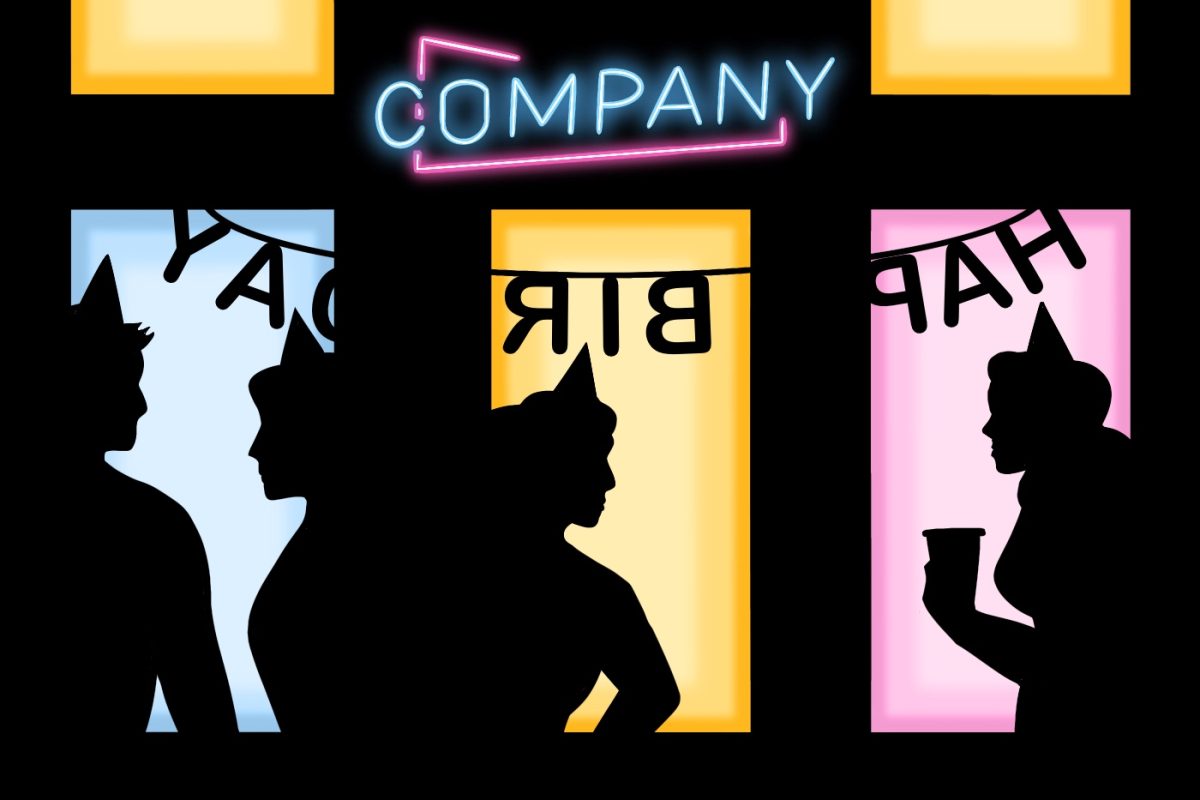
The School of Performing Art’s adaptation of Steven Sondheim’s “Company” was intimate and expressive, a testament to the unity and passion of the cast, crew and directors.
I regret to say this was my first time attending a Wichita State theatre performance, but I am a longtime lover of musical theater and the performing arts. My draw in attending the performance stemmed from my recent obsession with the musical “Company.” I have listened to its score repeatedly over the past six months. When I saw the show’s name on the fall schedule, it immediately drew me in.
“Company” stands out among Sondheim’s work because it explores a mundane, often awkward part of life — the plateauing feeling of mid-adulthood.
The musical is told in vignettes centering the protagonist Bobby, a 35-year-old bachelor, surrounded by people taking “the next step” in life — marriage.
I attended the 2 p.m. showing on Sunday, Nov. 16. The theater was essentially full, with a few single seats left empty, but I overheard attendees outside the venue say tickets had sold out in most of the showings, making me thankful I arrived early.
Bobby, played by Gabe Almodovar, sits on the outskirts of relationships, peering in, playing around, but not ready to settle down.
Almodovar immediately captured Bobby’s charisma upon entering the stage clad in bell bottoms and a denim vest. He brings a boyish charm, integral to a character clinging to his independence in a world obsessed with connection.
I found myself consistently impressed with his cadence and humor. Especially with a script written in the 70s – he made it feel natural.
The titular opening number “Company” introduces the audience to Bobby at his 35th birthday party. The actors surround the audience, updating Bobby on their lives and checking in on him in a repetitive, semi-demanding manner, creating an atmospheric surround-sound effect.
The entire ensemble had an impeccable blend and did justice to the complex harmonies throughout the show.
Vocally, Almodovar is warm and inviting. Bobby’s songs often build slowly, showcasing a wide range of pitch, which Almodovar executes vividly. He reminded me of Raul Esparza’s Bobby from the 2007 recording of “Company,” but with a younger tone and less abrasive, smooth vibrato.
The cast being college-aged, all a good 10 years younger than their characters, gives a unique charm to the show. The standout pairings to me were Harry and Sarah, played by Von Love and Issy Lynn, and David and Jenny, played by Gabriel Cornwell and Elena Cianciolo. Both pairs had incredible chemistry on stage together, in spoken word, choreography and song.
Harry and Sarah have a playful dynamic, showcased during “The Little Things You Do Together,” where Sarah showcases her “ka-ra-teh” skills on her husband Harry, while Bobby sits in a corner and observes. The two also stand out vocally, Lynn having a powerful yet worried tone and Love with a smooth silky voice. Love’s voice shines in the lamenting “Sorry-Grateful,” describing the complex nature of marriage.
David and Jenny are hilarious in their dialogue during a scene where they smoke on a balcony with Bobby. Cornwell and Ciaciolo showed off their finesse with the script, often drawing laughs from the audience.
In the scene, Bobby hallucinates being interrogated by his three lovers, Marta, Kathy and April, in a classic “You Can Drive a Person Crazy.” Liv Rivera (Marta), Zoie Dangerfield (Kathy) and Dot McMillen (April) gave a unified performance evoking anger and disappointment toward the noncommittal Bobby. Dangerfield sang the high harmony with accurate pitch, necessary to the role. In spoken scenes, she portrays a gentle love; a right person, wrong time sort of dynamic with Bobby.
Rivera showed a powerful and confident performance throughout as Marta, the sporadic, often chaotic partner of Bobby’s. She was charming to the audience and well-rehearsed with the track in “Another Hundred People,” which explores the ever-changing nature of the setting, New York City.
The costume design was very charming. The color palette alone invoked the 70s, with oranges, yellows, browns and muted blues, but the hair and costumes sank their teeth into the era. Joanne with an upturned bob, Amy with wild curls and a mix of bumps, bangs and beehives solidified the time period.
The Welsbacher Theatre was an incredible venue for the show. It was intimate, tucking the audience inside of the show, with stairs and balconies along the walls. I found myself near the stairs, feeling almost like I was peering through a picture frame on the wall of the set.
The real strength of the venue was the immersion.
Having to crane your neck up to get a better view of a conversation. Even sitting and staring at the back of someone’s head felt important. With the ensemble constantly rotating, it was effectively a 360 show. You never knew what angle you would be peering through into the scene.
Many of the musicals I have seen have been through a screen, but my favorite ones are similarly in immersive venues, like “Natasha, Pierre and the Great Comet of 1812,” or “Cabaret,” which almost envelop the audience in the set.
This style lends itself naturally to “Company.”
The ensemble frequently moved throughout the venue – sitting in pairs on the side of the theater and moving on a dime during the performance.
In tender intimate moments, the audience held its breath. At times it felt awkward, intrusive to be watching, but impossible to look away.
The lighting was also incredibly intuitive. The warm yellow light again invoked the 70s, cozy and illuminating. The lights guided the audience’s eye, which is necessary, especially during long, overlapping songs.
When sitting alongside the wall, each pair or individual had a light on them, opening up the “set.” Noticeably, there were also moments of isolation bathed in the blue and purple lights, when nothing could be seen in the room.
One of the best lighting moments came during “The Ladies Who Lunch,” when Joanne, played by Kaete Mokrynski, laments her life and the changes that have taken place in society around her.
Mokrynski did an incredible job portraying Joanne, one of the older, richer and more cynical characters in Bobby’s life. Her presence was there. The hair was great, and the costumes matched her more refined character wonderfully. In the first act, she stands above the show, looking in, before her deeper characterization in the second act.
During the climax of “The Ladies Who Lunch,” Mokrynski raises her glass, illuminated in blue and purple light. The light comes from above and creates four silhouettes of Joanne in fractured parts surrounding her on the stage. Mokrynski is bathed in a silver sequin dress, bedazzling the audience in light as she cries out powerfully, ‘Everybody rise.’
The choreography also added another dimension to the show. My favorite moments often came when the entire ensemble was on stage. “Another Hundred People” had a loveable section with the cast formed into subway cars, swaying and walking in character — with an added costume element to show they were “on the move.”
My Catch
There was one aspect of the show that was hard to ignore — the backtrack.
One of my favorite parts of “Company” is the instrumental music, an integral part of the show. My favorite iteration of the musical is the 2006 Broadway revival, which displayed actors playing instruments on stage during the show. Before attending, I did anticipate there would not be live music, but I was disappointed nonetheless. I also have to mention that since this is my first show, I’m unsure of the norms around backtracks in these types of shows or what the director’s options were, but my taste is deeply influenced by my background in instrumental and vocal music.
I played the flute for eight years and have sung in a choir since I can remember, though, unfortunately, those parts of my life dwindled when starting college. In a musical, I value the balance between instrumentalists and vocalists because they can adapt and live the music together.
At times in the show, when the ensemble sang together, it was difficult to notice the backtrack. But occasionally, during quieter moments, I would get pulled out of the story, partially due to the quality of the backtrack, which relied on electric, almost keyboard-like sounds reminiscent of a practice track.
Unfortunately, the background track often took the life out of impactful moments and transitions between songs. I don’t know what a realistic solution to that is, or if the directors were prescribed a backtrack when licensing the musical, but it did take away parts of the show for me.
Despite this, the cast was extremely accurate and tight with the track. Their timing displayed the amount of behind-the-scenes practice put into the show.
There were rare points where there was some lagging behind the track, but overall it was incredibly polished. Amy, played by Lexye Collins, showed an impressive amount of control over her diction, timing and vocal tone during one of the fastest and most difficult songs in the show, “I’m Not Getting Married Today.”
Sondheim is generally incredibly difficult to sing and perform, often pushing actors to the limits of the human voice and lung capacity. “I’m Not Getting Married Today” is no exception. Collins sings at an anxious pace at 163 bpm at its fastest moments, switching between half and double time throughout, displaying her character’s fear and desperation around her wedding day. Collins’ performance showed a deep familiarity with the track, matching it in rolling speed.
Because of the lack of live instrumentals, the ensemble was the heartbeat of the show. They had an incredible blend and an almost percussive sense when moving around the stage.
During the second act, Bobby is almost tormented by those around him who love him. Unsure of his desires, he goes through the motions of life, which Almodovar represents wonderfully through his dry and uncaring tone displayed in his interactions with April.
The two of them balance each other out in their scenes together. McMillen plays a flighty, hopeful and naïve April, and Bobby matches her youthful passion with his dejected, empty responses.
In the last moments of the show, we see Bobby accept the possibility of relationships and commitment in the song “Being Alive,” being tugged along by his friends calling to him on the outside of the stage. His vocals grow in slow acceptance, which builds to a clear belt at the finale of the song.
The show calls back to Bobby’s surprise birthday party, but this time he didn’t show up. He returns to his apartment after all of his friends have left, and blows out his candles, finally in a moment of contentment.
Overall, it was an impressive show. It showcased a range of talent I am so delighted to see on this campus, and I will now challenge myself to see as many shows as I can before I graduate.
Though I was drawn in by Sondheim, it was the people involved in this show that stayed in my mind after leaving the theater. Now, when I listen to the 2007 album, I will imagine myself tucked into the November show in the back of Welsbacher Theatre.
Editor’s note: A previous version of this story incorrectly identified the pairing of Harry and Sarah, played by Von Love and Issy Lynn. The full list of contributors to the production of “Company” can be found here.