



Growing up, Native art and artists surrounded Anna Tsouhlarakis, who began making art herself between ages three and four. Her pieces have traveled the world, and one has made its way to the Ulrich Museum of Art on campus.
“We were always doing things, making things. But it wasn’t like ‘Oh I’m making art,’ I just thought we were messing around,” Tsouhlarakis said. “It was always something I did … it was really at Dartmouth College where I began to see that making work was a possibility as an artist.”
Tsouhlarakis is Navajo, Muscogee Creek and Greek. She was familiar with traditional Native crafts that she made growing up, but wanted to explore other ways of creating. That exploration came in college.
“I started seeing that there were trajectories of different ways of making within African American art, Latin American art and Asian American art,” she said. “I was wondering where that was for Native artists … (art) was a language I understood, where I could bring different objects together and speak about Native issues. I could speak about my identity, and it was a way for me to kind of talk about it in an artistic way.”
Tsouhlarakis’ first creation in college was “Navajo Baby Blanket,” a blanket made of knitted squares and aluminum beer cans.
She said that she has a lot of alcoholics in her family and the blanket was her way of speaking on the issue in a new way. Themes of Native identity and issues became prevalent in her art, especially as she exited college.
One question became a guiding principle in her work, and still is in the work she produces today, Tsouhlarakis said, “What kind of works need to be made about Native identity that hasn’t been talked about before?”
She began exploring Indigenous futurism – a genre that uses aspects of science to imagine the future from an Indigenous perspective – with a piece in 2002 entitled “Rocketship” that she eventually revisited in 2022.
The original rocket ship, which was 12 feet tall and was primarily silver, was made of found objects and had a large chain on top. The sculpture was paired with a piece that she wrote.
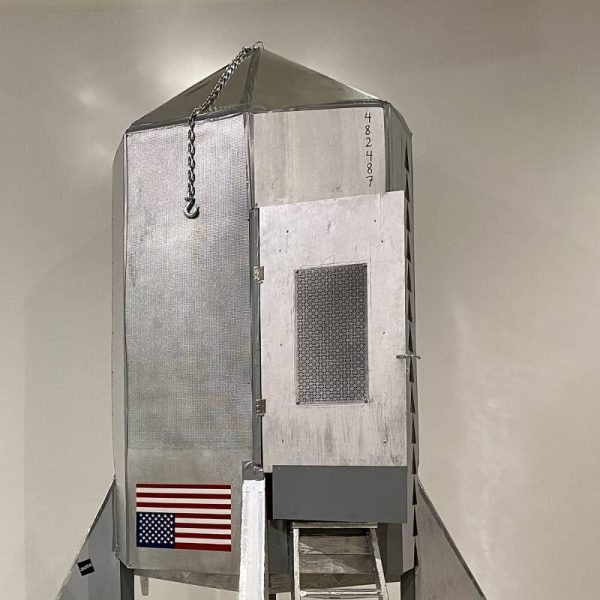
“When the natural resources of Earth start becoming scarce, many people will look towards the option of leaving this planet in hope of finding another planet that will sustain life. While most people will be in the fancy, sophisticated NASA type space shuttles, there will be people, such as Indians, who cannot afford such a luxury and will have to build their own ships. These less complicated rocket ships will not be able to take off on their own, and will have chains that hook onto the larger rocketships. But one thing each of these shoddy rocket ships will have is an escape hatch in the floor. As all of the larger spaceships begin their countdown to take off, all the Indians will be slipping out of their escape hatches. The Indians will be putting their feet on the ground while everyone else is on their way out of here,” she wrote.
She said that the rocket ship was built to comfortably hold five adults, and when she revisited the piece in 2022, she built two additional to make a set of three for her three children.
“(The revisited) piece is called ‘Rocketship 3/4,’” she said. “I use 3/4 in a lot of my work … my biological mom, I didn’t know her. I knew my grandmother, and then there’s me, and I have kids, so there’s 3/4 of a generation known … (and) I was pregnant four times but I have three children.”
She said she also works to break down a lot of the “glamourous Native woman” stereotypes in her art.
“I wanted that to be out in the gallery – in the museums,” she said. “I wanted that relaxed kind of idea of who Native women are out there, that imagery, to be a part of the conversation and dialogue.”
An example of this in her work is a piece called “Let’s Dance,” a video of her journey learning dance moves from different people she’s met. More than 20 art venues around the world have displayed “Let’s Dance,” making it one of her most traveled pieces.
After graduating college, Tsouhlarakis moved around a lot and produced a couple of larger pieces, one of which opened up in Albuquerque, New Mexico, and was part of a statewide exhibit with an overarching theme of time.
“Mine was kind of the kickoff piece,” she said. “I wanted to attack this theme in a more complex kind of meta way. I decided to go at it through the ideas of Navajo creation stories … It’s such a rural spread out tribe that our stories have slight differences, and that was something I wanted to kind of tap into and capture.”
The piece itself is made of wooden walls arranged in a spiral with aluminum signage that has phrases she gathered from the people she knew. The wood came from her family land, and as people travel closer to the center, the walls get taller.
Tsouhlarakis said that a lot of her work is sarcastic and humorous. During the COVID-19 pandemic, when a lot of communities were calling for decolonization of art and institutionalized spaces, like museums, she said she sat down and asked herself what decolonized art would look like.
She said that she always tries to push boundaries and definitions, forcing people to conceptualize that something might not always look like what they think it will look like.
This evolved into her idea of billboard text pieces that have been put on display in several states. They use the idea of responsive classroom learning, which is a form of positive reinforcement.
“I started thinking about that in terms of Native interactions, and that’s where the Native Guide Project was born,” she said.
The Native Guide Project is a series of 23 different phrases like “I really like the way you respect Native American rights,” and “When you listen the land speaks” posted on social media sites and on billboards across the country.
“It’s me … invading that space,” she said. “I like that idea of invading people’s space for a moment to have them think about these things.”
In 2021, Tsouhlarakis won a Creative Capital Grant of $50,000 to create the “exhibition of (her) dreams.”
She used that to create “Indigenous Absurdities,” which is made up of six sculptures, six collages and a video.
“I was really interested in focusing on the use of humor within the text,” she said. “I had used sarcasm more subtly in the ‘Native Guide Project’ but (in) indigenous absurdities I wanted to pull on it more. I hadn’t seen in the (art) world … this use of raw humor that specifically Native women use for roasting each other.”
Tsouhlarakis said that she uses the pieces in the collection as portraits of Native women. Particularly, “She still thinks her shit smells like sage” is about a Native woman who thinks she is incredibly luxurious.
“You have the rabbit fur, you have these really shiny beads … she may seem elegant in so many ways but there’s a big pile of screws underneath, meaning she can screw you over at any time,” she said. “I like that idea of ferocity and rawness about womanhood that we don’t often talk about.”
“She still thinks her shit smells like sage,” has been acquired by the Ulrich and it is on display in the Dr. Sam and Jacque Kouri Collection Study Center.
