



Christmas 1957. Mike Kennedy was 9 years old when his father bought him his first basketball and hoop — and with them, a crystal set radio, the kind you needed headphones for, the kind that whispered entire worlds to a child willing to listen.
At night, he lay in bed with the headphones clamped tight, letting the thud of dribbles, squeaks of shoes and the haze of radio static fill the darkness. The walls fell away. Only the sound remained.
Long before he could drive, he knew the cadence of those voices — steady, familiar, alive. Kennedy didn’t know it then, but he was learning the rhythm, the timing and breath he would one day carry himself.
In his Wichita bedroom, stacks of Dell Sports and Street & Smith magazines softened around the edges. Their stories more than their covers shaped how he imagined the game. In the backyard, he turned the stories he read — and the voices he heard — into imaginary games on the hoop his father hung.
For a boy, the radio made the world feel intimate. For a future broadcaster, it became a compass — a quiet map of where his voice would eventually travel.
Looking back, Kennedy now sees what that child couldn’t yet name.
“The whole connection between sports on the radio and sports was there from the beginning,” he said.
Nearly seven decades later, the child who once fell asleep to those broadcasts is preparing to sign off. After 46 years as the Voice of the Shockers, Kennedy will retire following the 2025-26 season — a decision that, like that first spark in 1957, came quietly but unmistakably. A beginning whispered in static now meets its quiet conclusion.
He shared the news first with longtime color commentator and friend Dave Dahl over a meal this past summer. Dahl was surprised, but not shocked; he knew Kennedy grappled with a question only he could answer.
Kennedy was coming off cancer treatment that forced him to miss two games during the 2023-24 season, ending a streak of 1,419 consecutive men’s basketball broadcasts. The boy who once listened in the dark and the man who spoke for generations were suddenly face-to-face with something neither of them could control: time. The uninterrupted rhythm of a lifetime paused — and it demanded reflection.
Dahl pressed gently, the way friends do.
What would happen if Wichita State was really good? What would happen if they went to the NCAA Tournament? What if they were in a fight for the league championship?
Kennedy’s answer stayed the same each time.
“He was concerned about what our thoughts were, not how we would take it,” Dahl said. “It wasn’t as if he was asking my permission, but just making sure that I was OK, and I felt comfortable with the decision that he was making. It speaks volumes about him.”
Family pulled at Kennedy in ways a job no longer could: granddaughters competing in Division I athletics; others in Wichita he hadn’t seen as often as he wanted; sharing more moments with his wife, Debbie.
Friends told him he would know when it was time. Eventually, he did.
“I still love it, but it’s time,” Kennedy said. “I know it’s time to move on to something else.”
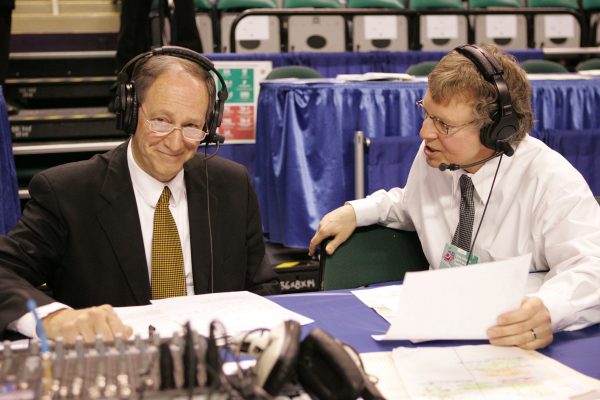
Finding the frequency
Long before Kennedy became the full-time voice of Shocker athletics, he imagined himself using his voice differently. Majoring in vocal music at Wichita State, he planned to teach.
Baseball fantasies faded — but the broadcast signal, faint yet persistent, never disappeared.
Then, a chance conversation shifted the frequency back to that childhood spark. A single sentence realigned the dial. Kennedy mentioned to a teacher he knew that he wanted to try sports broadcasting instead of teaching.
“‘The only way you’re ever going to know is to go try it,’” was the answer Kennedy recalled. Simple advice, but exact. It nudged him toward the thing that had been calling him since that Christmas when he was 9.
A radio broadcasting class at KMUW Wichita Public Radio drew him in. Jobs in Chanute and Pittsburg followed. By the 1980-81 season, he returned to Wichita as the full-time play-by-play voice for men’s basketball and football.
Basketball led to baseball. Later came volleyball. Even when a chance to call Houston Astros games came into the picture, the pull of home and community out spoke the opportunity’s call.
“The more I established relationships, it just started to feel more and more like that’s where I should be,” Kennedy said.
When the streak fell silent
There are two figures Kennedy will never forget: Feb. 15, 2024, and 1,419.
That night, a recent prostate cancer diagnosis forced him to miss a game. His 1,419-game streak was over. He said he felt bummed about not being there — until messages poured in. His phone filled with texts and emails from family, listeners, colleagues, former players and friends.
“To know that you connected with people and made an impact on people over that time… it might have been the best night of my life,” he said.
And through treatment, Dahl said, Kennedy was unwavering.
“He was the same. It was the same guy,” Dahl said. “If you didn’t know, you would have never had guessed it. He still looked to the future. He still prepared as much for each game. His performance on each broadcast was equally as good as they had ever been.”
The streak’s end didn’t diminish his career — it clarified it. After thousands of broadcasts, Kennedy understood that the true measure wasn’t in games called, but in the lives tuned to his voice.
A voice woven into Wichita’s fabric
Across decades of games, Kennedy can point to moments that made all the miles worth it: the 1988 Regional win in Stillwater, the call as the Shockers won their first College World Series, the 2013 Final Four run, the 35-1 season that ended in what Kennedy said might be the best game of basketball he’d ever been a part of.
There were awards, hall of fame inductions and tributes that recognized his impact in the broadcasting world and Wichita community. But just beyond those highlight reels lived what mattered most: relationships. Not the calls on the microphone, but the bonds behind them.

Brent Kemnitz remembers their first connection during the 1982 run that sent Wichita State to its first College World Series. Kemnitz was the pitching coach at the time, and the bullpen had just given up a single run in three games.
“He’s just such the ultimate pro,” Kemnitz said. “We just had a great friendship, almost from day one… He’s as good a friend as you’re ever going to have.”
Dahl felt the same warmth as long as he could remember — a friendship built on dinners, conversations and shared time away from the court.
Fans felt it too. Many muted their TVs just to hear Kennedy on the radio.
“I know a lot of people when games are on TV, they would turn the TV volume off and then listen to Mike Kennedy,” said KMUW News Director Tom Shine. “He has introduced hundreds of thousands of people to Shocker athletics. He’s made them fans of Shocker athletics because of his work as a broadcaster.”
And to those who worked closest with him, Kennedy’s voice is only part of what makes him unforgettable.
“The thing that anybody who truly knows Mike (knows) is, you have a great friend,” Kemnitz said. “Somebody that’s going to be there for you. Somebody that’s going to support you. Somebody that you know is just a quality person that you enjoy being around.”
To Kennedy, those relationships formed the truest archive of his life’s work. The real record wasn’t on tape — it was in people.
“I’ve been blessed,” he said. “To do something I love, and to do it at my school, my university, all these years. It’s been an incredible run.”
“Forty-five years of students have come and gone to Wichita State,” Shine added. “If you’re in the freshman class of 1980, and you’re in the freshman class of 2025, Mike Kennedy is the Voice of the Shockers. That’s the only guy you’ve ever heard.
“It’s going to be a big change for people. It’ll be a big change for me.”
When Kennedy finally steps away from the booth, it will be the end of a streak, but not of his story. The voice that echoed through Wichita State’s highs and lows won’t be heard over the airwaves anymore, but it will live on in the same memories of fans, in the relationships he built, and in the way he helped shape the university’s identity through his words.
Because, in the end, what he’s really leaving behind isn’t a career marked by titles or numbers — but a lasting, unwavering connection to a community that always knew exactly who was calling their game. A voice that, through it all, never stopped listening.
And when he finally rests the headset, the voice that carried so many seasons will settle into memory — just as another once did for a boy in the dark who listened for voices, and one day became one.
The signal that started in a child’s bedroom will fade, not vanish — carried forward by all who heard it.


Anonymous • Apr 29, 2026 at 12:14 am
Fantastic article! Growing up in Wichita I listened to him a ton. Just a huge part of my life! Great work and nice tribute!
Eldon Hamm • Nov 30, 2025 at 3:05 pm
A Great article…great job