Warm light spilled across the south face of the Ulrich Museum of Art on Wednesday, Nov. 12 and caught on the edges of 350,000 pieces of Venetian glass. Ladybugs drifted lazily through the air, landing on color-splashed tiles as a scissor lift reached its peak.
Conservators Marianne Russell-Marti and Andy Breidenbach steadied themselves against a slight wobble — nothing concerning, just the natural sway that comes with working eye-to-eye with Joan Miró’s monumental mosaic “Personnage Oiseaux.”
Then, they began again: micro-fibre towels, a motorized toothbrush and patience. Tile by tile.
They’ve done this on and off for years.
“You can’t just have a work of art, put it up and forget about it, because they will deteriorate in the outdoor environment,” Russell-Marti said. “Everything needs maintenance.”
Breidenbach, who has worked alongside Marianne for about 30 years on mosaic conservation, has recognized the cleaning process isn’t simple.
“If you wipe it with a damp cloth, it’ll look good. It’ll saturate and look really pretty,” Breidenbach said. “But as soon as the water evaporates, we’re back.”
Relationship built over decades
Their partnership with WSU goes back even further. In the mid-1990s, a Kansas City museum colleague recommended Russell-Marti’s conservation firm to The Ulrich.
Breidenbach, who earned a degree in engineering before moving into art conservation work, has been with the mural for three decades; Russell-Marti has led its conservation for nearly as long.
They arrived in 1995 for their first survey of WSU’s outdoor sculpture collection. By 1997, they were already scaffolding, re-adhering thousands of loose tesserae.
For Russell-Marti and Breidenbach, the Miró mural is not just a job to fix. It is a relationship – one built tile-by-tile and year-after-year.
Every fall during annual maintenance, they would spend a full week reattaching glass.
“When we first started, every time we came there’d be more pieces on the ground,” Russell-Marti said. “It was literally falling apart.”
For three years, they surveyed the artwork’s needs. The full restoration took six more.
Today, the mural is stable, strong even, thanks to stainless steel backing, thousands of hand-cleaned glass pieces and years of engineering to help the piece endure Kansas’ sun, wind and mood swings.
Russell-Marti said the backing replacement was “all Andy did” until 2016 when the mosaic was back to spiff.
Now, the team returns every few years for cleaning and assessments.
“We’re doing it every three years,” Breidenbach said. “That’s probably optimal. We’re just doing it to keep that haze from building up to the point where it won’t come off without Herculean efforts.”
“It feels great,” Russell-Marti said. “We’re really proud of the treatment and the partnership with the Ulrich Museum. It’s gratifying to see it holding up so well.”
The only mosaic of its kind
The “Personnage Oiseaux,” which is French for “Bird People,” is the only mosaic Miró ever made. That uniqueness is not just a point of pride. It is a responsibility.
“This is the only mosaic like this in the world,” Russell-Marti said.
Breidenbach, who has studied Miró’s original reference painting countless times, often explains the structure.
“The mural was generated from a painting,” Breidenbach said. “It was four by eight — same proportions, eight feet long and four feet tall. The white and the gray represent the canvas and the background where there isn’t paint.”
Up close, the piece reveals its strangeness and brilliance with bright, irregular shapes. What appears jet black is an array of deep colors. In Miroó’s original painting created to map the intricate mural, the Bird People are illustrated with paints onto a plain canvas. The enchanting glass replaces the paint, and matte white marble references the original canvas.
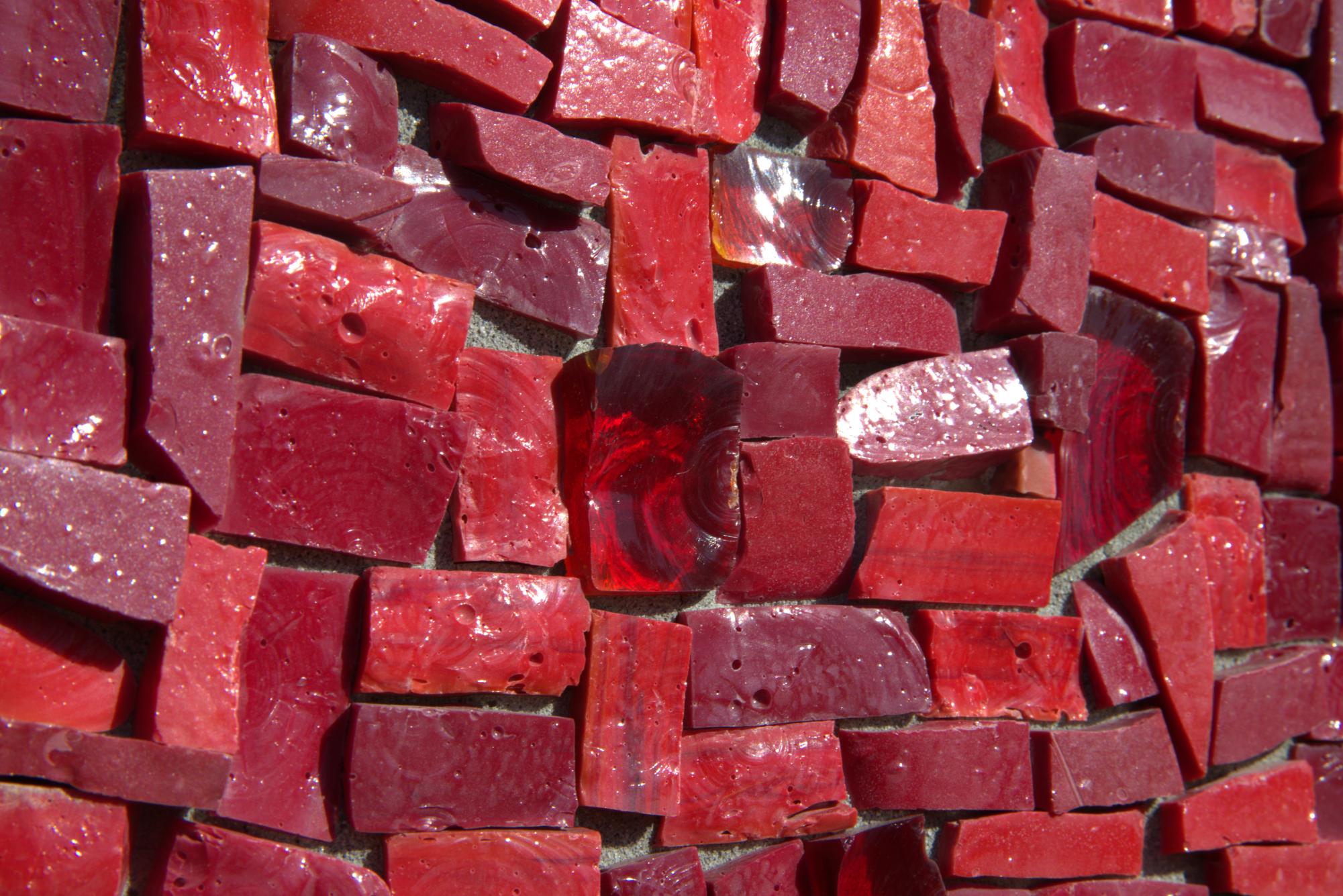
It is a mural that rewards the observer, the person who can get close enough.
“That’s what I love,” Russell-Marti said. “The way they used color to turn a two-dimensional painting into this three-dimensional work of art is just stunning.”
Why they keep coming back
The team’s tools are humble: soft brushes, cloth, a toothbrush for the most stubborn crevices. There are no shortcuts.
“It seems like a low-tech way to clean this, but it really is the only way,” Russell-Marti said. “You have to get into every little crevice.”
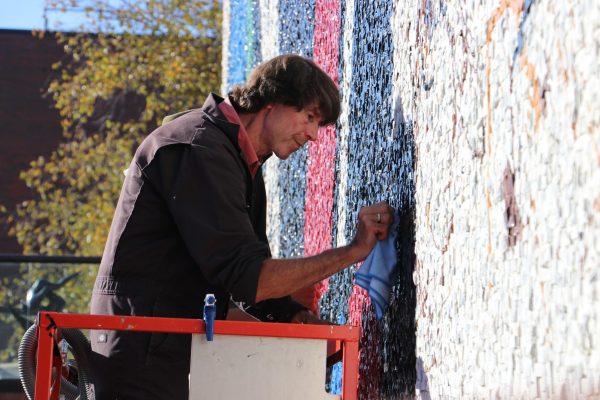
Breidenbach agreed. “It’s time-consuming. It’s tedious,” he said. “But actually, there is no other way to do it.”
The enemy is a thin, almost invisible film that slowly creeps across the glass as Kansas weather moves across the surface.
“We’ve experimented with all kinds of cleaning methods, and really the best way is by hand — every nook and cranny,” Russell-Marti said. “If we don’t, the surface haze will just grow and become very difficult to remove…you’d need much harsher methods that could harm the glass.”
The mural faces harsh Kansas summers, and the engineering helps it survive them. Behind the glass is a ventilation system few people notice.
“Underneath there is a screen, so air is able to flow up like a chimney,” Breidenbach said.”As it heats, it rises. So it pours out at the top — there’s a good flow on the backside. If it weren’t for that, this would be pretty roasting hot. You wouldn’t be able to put your hand on it.”
Despite its damage from the southern-shining sun, the mosaic’s conditions can make for an easier clean-up process.
“If it faced north, that would fix the harsh sun problem,” Breidenbach said. “But the white marble would have organic growth all over it. There’s almost no easy answer.”
The Ulrich Museum’s commitment to the mural is not lost on the people who care for it.
“The university’s commitment to maintaining this is really commendable. Outdoor art needs ongoing care, and they’ve made it a priority,” Russell-Marti said. “That’s good stewardship — and it’s rare.”
Conservation requires repeated investment, often invisible to the casual onlooker. But WSU has kept the Miró at the center of its identity – and its budget – for decades.
Even on a bright fall day, the work is slow. A panel that looks “pretty clean” from the ground can take hours once the scissor lift rises and every glint of light reveals what the haze has hidden.
But Russell-Marti and Breidenbach seem energized by it — by the quiet discipline and knowledge that they are preserving something that cannot be replaced.
“That’s why we went into this profession,” Russell-Marti said. “We enjoy the art, we enjoy hands-on work, and we love solving problems.”
Down below, the museum lobby fills with students, artists and events. Drivers slow down as they pass, noticing the mosaic.
Russell-Marti has one request at the end of the shift: “Beam us down, Scotty,” before the lift lowers them back to earth.
Most don’t notice the ladybugs or toothbrushes. But they notice the mural. They always have.
Because of this team, they always will.