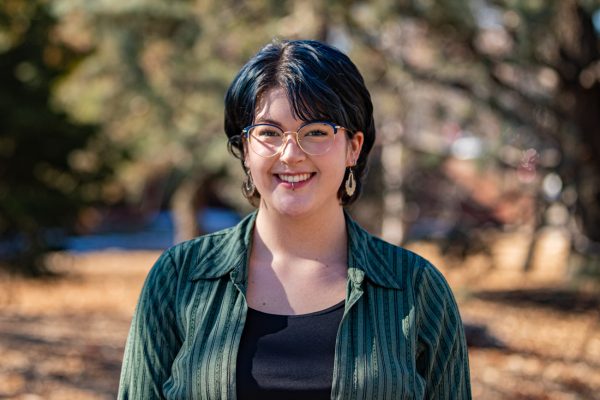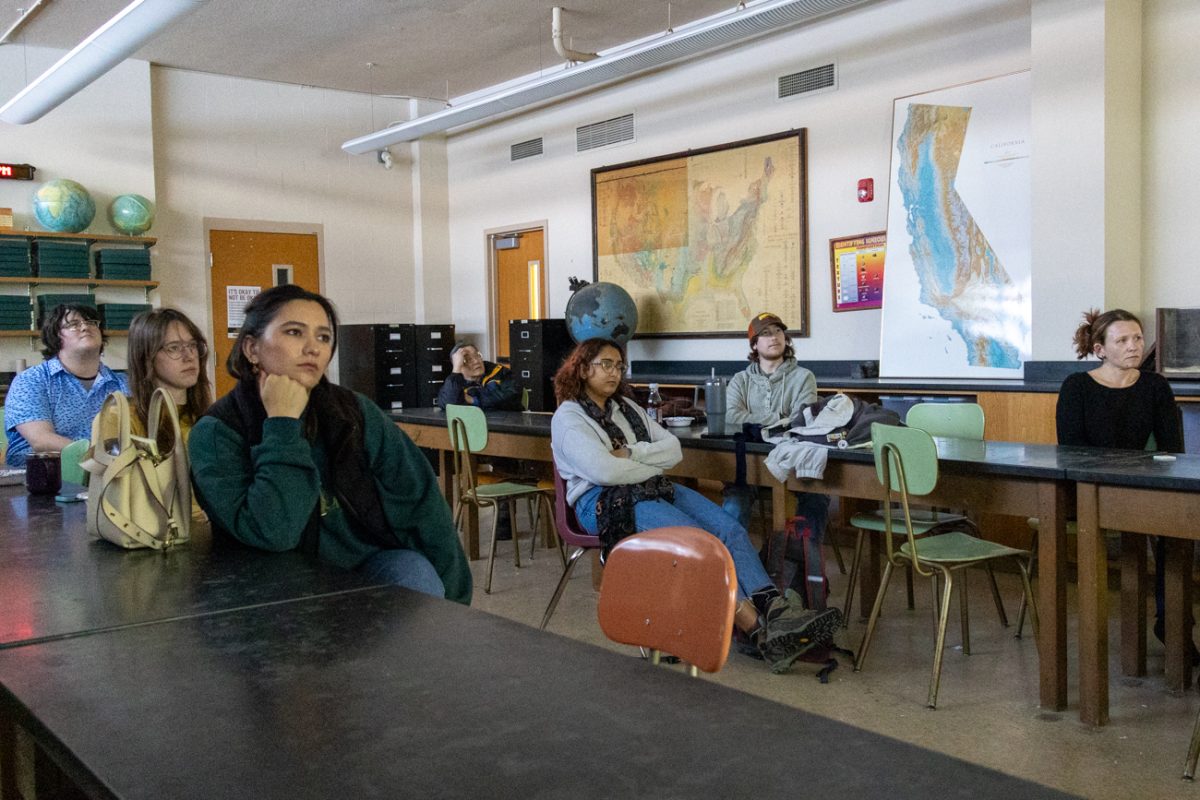
A small crowd couldn’t dim the enthusiasm of Melissa Scruggs, Wichita State’s resident volcanologist, who excitedly introduced herself to the room before the free showing of “Fire of Love” on Thursday.
“Fire of Love” is a 2022 documentary covering the lives, love and ultimately tragic deaths of volcanologists Katia and Maurice Krafft. The documentary originally showcased at the Sundance Film Festival and later received awards including the Satellite Award for Best Motion Picture and a Peabody Award.
The documentary was a rollercoaster of emotions, explosions, and excellence. It has an odd sense of humor — strangely reminiscent of a Wes Anderson classic. The Kraffts make the documentary easy to watch with their dry wit. The stunning imagery comes second to the emotional nature of the subjects, whose passion for their life’s work shines through the film. While maybe not a “must watch,” this film is certainly a good watch.
The documentary’s subjects, Catherine Josephine Conrad and Morice Paul Krafft, who later Americanized their names into Katia and Maurice, met during their studies at the University of Strasbourg. Katia graduated with degrees in physics and chemistry, and Maurice finished his varied education alongside her. The pair are joyous and lighthearted, riffing with the other and delivering soft handed insults like bickering pensioners.
The two were married in 1970 and honeymooned, as all volcanologists do, on the volcanic island of Stromboli. During their honeymoon, they captured its near continuous eruption. The picturesque cinematography of their travels invoked a deep sense of wonder, resulting in “oohs” and “ahhs” from the audience.
The Kraffts had a reputation among other volcanologists for often being the first to arrive on the scene of erupting volcanoes. Perhaps their biggest impact was resulting from their footage of the 1985 Nevado del Ruiz eruption in Columbia. The eruption had led to what would become known as the Armero tragedy, when lahar, a violent volcanic mudslide, came down upon unprepared towns near the base of the volcano. The audience held their breath during the intense scenes of despair and destruction.
The Kraffts are credited with helping convince people, including the then President of the Philippines, that an evacuation was necessary.
Katia and Maurice’s love story burned out far too soon when they met a tragic end in the pyroclastic flow of the 1991 eruption of Mount Unzen in Japan. Their bodies were recovered beside each other. Two items were recovered with their bodies and used to identify them — a camera and a watch. The narrator speaks in a more solemn tone during these scenes, showing a sign of respect and appreciation for the Kraffts.
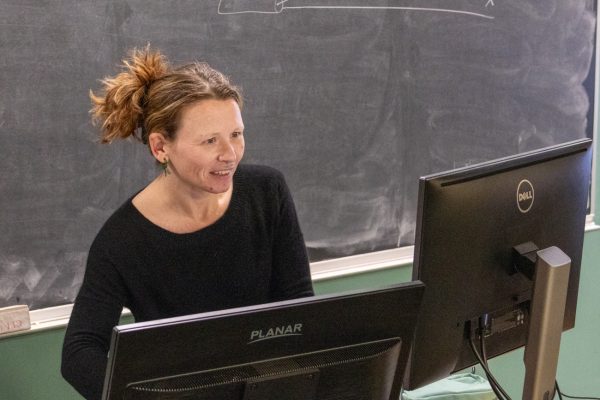
The Q&A following the showing was short but enlightening. Professor Scruggs seemed eager to answer questions and excited by the idea of talking about her work.
“In my perspective … they (the Kraffts) did take some unnecessary risks,” Scruggs said. “But at the same time, the risk that they took produced footage that helped to save lives … I think that I hope to either die in my sleep after a long happy life, surrounded by my family, or at the base of a volcano.”
If you missed this one, worry not. Wichita State has semi-frequent movie showings.
The next one on the events calendar is Black History Month Movie Night featuring “Marshall” at Hubbard Hall on Thursday, February 12th. “Fire of Love” can be streamed on Hulu or Disney+.