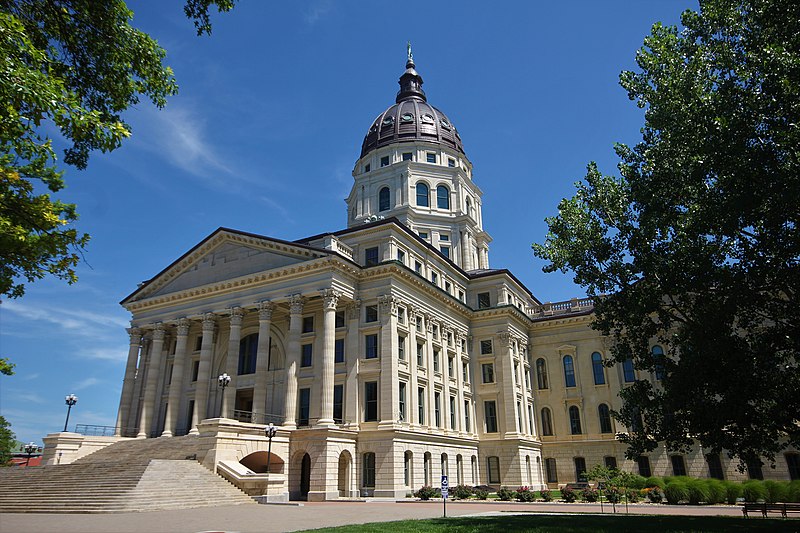
On Jan. 28, the Kansas Legislature approved Senate Bill 244 that would effectively outlaw individuals using bathrooms and identification, like a driver’s license, that doesn’t align with their sex at birth. After legislative approval, the bill goes to Gov. Laura Kelly, who can veto it or sign it into law.
Rep. Susan Humphries, a Wichita Republican who helped to carry the bill on the House floor, said that the legislation is an attempt to protect the safety of women.
“Right now, anyone can walk in any bathroom,” Humphries said when presenting the bill. “This is about making it really clear who can go in each restroom,” she said.
Humphrie motioned to “gut and go” SB244, placing the contents of HB 2426 into Senate Bill 244. The amendment added language about bathroom usage in government buildings requiring people to use the bathroom that matches their biological sex as recorded at birth, and Kansas governmental buildings to designate multi-occupancy bathrooms, locker rooms and showers as either male or female.
Rep. Bob Lewis, a Republican from Garden City, offered the bathroom amendment at the Jan. 26 meeting to expand House Bill 2426, after the House Judiciary Committee began working on it. The addition of the bill had no opportunity for public input.
Typically, the House is required to wait a day after the debate period of a bill before voting, but House Majority Leader Chris Croft — an Overland Park Republican — issued emergency action to vote immediately.
Representative Abi Boatman, a transgender woman, said that the bill would be “devastating” to transgender Kansans. Boatman serves House District 86, representing the south side of Wichita.
“I have sat here for five and a half hours and listened to this entire room debate my humanity and my ability to participate in the most basic functions of society,” Boatman said at the end of the debate. “From the bottom of my heart, I hope none of you have to ever sit through something like that.”
In an email statement to the Sunflower, Boatman said “any single part of this bill is bad enough on its own, but the amalgamation of the driver’s license ban, the bathroom ban, and the bounties is especially egregious and very much signals ‘open season’ on transgender people.
The bill passed 87-36 in the House after a six-hour debate, in which several suggested amendments by Democrats were rejected. The Senate voted 30-9 in favor of the legislation. It is now headed to Gov. Laura Kelly, who has vetoed anti-LGBTQ legislation in the past. Kelly has 10 days, excluding Sundays, to either veto or sign the bill
If Kelly vetoes, the bill could still be enacted into law with a two-thirds vote from the House and Senate.
Impacts of the bill
The bill outlines punishments if a public building doesn’t maintain the required space for males or females. If someone used a bathroom not matching their biological sex, the first violation would result in a written notice, the second could include a $1,000 penalty, and the third would result in a misdemeanor.
The bathroom portion of the bill also does not include a fiscal note, a formal budget analysis of how much a bill would cost if implemented. The lack of financial analysis can create a gray area around how much local governments and state entities would have to pay to enforce the law.
Governing bodies would be fined up to $25,000 for not enforcing the rule for a first occurrence and $125,000 for each time after.
Genesis Merriett, president of Spectrum, WSU’s LGBTQ and allies support organization, said they worry about the harm the bill would cause.
“(The bill) harms everybody because now people are going to be entering public restrooms worried about ‘Oh do I look female enough? Do I look male enough?’” Merriett said. “Even cisgendered people that have never had to worry about that before are going to have to start worrying about that.”
“If you’re not deemed woman enough or man enough to be entering a specific restroom, bam, now you have the risk of getting sued or having civil and criminal penalties put on your record.”