


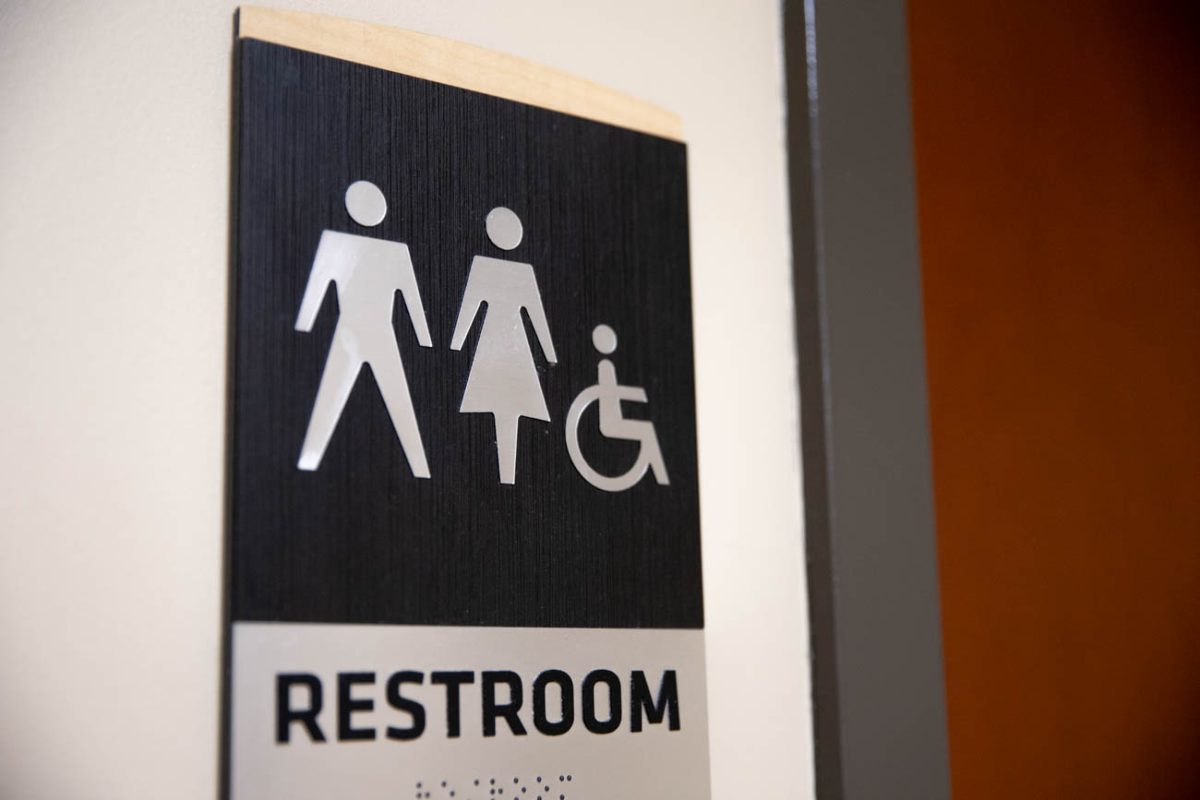
There are new restrictions on who can use bathrooms and other single-gender spaces in all state properties, including university buildings, and some Kansans’ driver’s licenses may be invalidated.
But the enforcement of these measures will be delayed.
House Substitute for Senate Bill 244 was passed into law in February despite a veto from Kansas Governor Laura Kelly, after it secured two-thirds majorities in both the state House and Senate.
It is already facing a lawsuit by two trans men from Lawrence, whose lawyers argued it violates their clients’ constitutional rights, including privacy, due process and expression. They also argue it could subject the men to discrimination and harassment and put their jobs and mental health at risk.
The law may be suspended for up to 14 days due to the lawsuit, after a hearing Friday. The Kansas Reflector reports a decision on that delay won’t be announced until at least Tuesday.
Enforcement of some aspects, however, will be delayed until March 26. According to the Reflector, Kansas Attorney General Kris Kobach told the judge on the case that affected Kansans have until the 26th to update their driver’s licenses. State institutions, including cities, counties and public schools, have the same grace period
Moe Hatfield, a sophomore at Wichita State, said the legislation has already affected their experience on campus — even before the bill passed.
“As someone that’s nonbinary and tends to present mostly androgynously, I already had concerns about my safety using the bathroom,” said Hatfield, who also serves as an ambassador for Spectrum, WSU’s LGBTQ student group. “And these concerns have only escalated. I’ve already had issues where people have very obviously looked at me questioningly when I use the bathroom. I’ve had people ask me if I’m sure I’m in the right bathroom.”
How will the law be enforced on campus?
It’s unlikely that any particular measures will be taken by the university to prevent people from using restrooms that don’t align with their sex as recorded at birth.
Genesis Merriett, the president of Spectrum, said it raises concerns for them about potential violations of privacy.
If a person is caught using facilities that do not align with their gender assigned at birth, the first violation will result in a written notice, the second could include a $1,000 penalty and the third would result in a misdemeanor.
Private citizens would also be able to sue people they think have violated the law.
“It’s kind of like — what are the logistics going into that?” Merriett said. “Do we have people that are going to be checking IDs outside of every bathroom now, like, security, that’s going to be willing to go as far as pat people down?”
Zach Gearhart, WSU’s chief of staff and executive director of government relations, said that’s not likely to happen.
“I think all parties involved have acknowledged that it’s not practical to have people monitoring that,” Gearhart said Friday morning at a meeting to update students, staff and faculty on the legislature. “I think what they’re looking for is, ‘are you making a big effort to follow the law,’ which is largely having the appropriately marked bathrooms for multioccupancy (bathrooms) and if you are brought complaints, ‘are you following the law for dealing with the complaints?’”
The law does not include direction as to how institutions, such as public universities, should enforce this measure, leaving it up to each organization. But state bodies would be fined up to $25,000 for failing to enforce the rule on a first occurrence and $125,000 for each time after.
It bans these institutions from having gender-neutral restrooms with more than one stall, but does not affect single-stall facilities. Multi-occupancy spaces such as locker rooms or theater dressing rooms are subject to the law, however.
Effects on trans and gender-nonconforming people
Hatfield said they began to notice an escalation in uncomfortable or hostile interactions in campus facilities before the law even took effect, rather, since it was first introduced and public awareness of the bill grew.
“I already had discomfort before this bill passed,” they said. “And now I’m like — I fully am using the facilities that I’m legally supposed to, and I could show you my driver’s license that has the female marker, and that shows that I’m supposed to be in this bathroom, but I don’t think that would help any situation.
“I fear that it will likely only continue to affect me as I’ve started more of a process of medically transitioning. So even if I continue to use the women’s restroom — which for this legislation, I am supposed to — I fear it’s only going to continue to affect me more.”
Merriett said Tuesday, they hadn’t yet heard from many students who were impacted by the ID portion of the legislation. Many trans Kansans who had previously changed their gender markers received letters telling them their IDs had been immediately invalidated after the law took effect.
“It is just a bit smaller of a population that has actually had their birth certificate and ID changed to match the gender that they would like to be identified as,” Merriett said. “I’ve only met one person that has gotten that letter. And honestly, there haven’t been a lot of people reaching out to me. And I don’t know if that’s just because it is so few students (who are impacted) or if that’s because they just aren’t even sure where to start.”
Concern about scrutiny in bathrooms impacts Hatfield’s day-to-day life on campus.
“I’ve gotten to a point where I have been purposely drinking less water, when I know I’m not going to be somewhere where there’s a gender neutral bathroom, specifically to avoid having to go to the bathroom in gendered restrooms, because I’m afraid of potential backlash.
“And I know I’m not the only person that has started taking those steps.”
The plaintiffs’ representatives in the lawsuit against SB244 have argued that the law will negatively impact their clients’ mental health.
Echoing this, Hatfield said, “When these bills pass, or even just seeing them be proposed, it drains the mental health of so much of the trans community. And I personally know my mental health has gotten worse following this bill.
“It’s bad when I am informed and know what’s going on, because I see the reality of the situation. And it’s worse if I don’t keep myself informed, because… my brain is creating all these ‘what ifs,’ and it’s just really like — there’s no good way to exist when people are legislating against my existence.”
Gender-neutral bathrooms on campus
Wichita State’s campus has gender-neutral, single-stall restrooms in several campus buildings.
In 2023, the Student Government Association and Spectrum partnered to create a more map of gender-neutral bathrooms. A list of some buildings that have these restrooms is also on the university’s interactive campus map. This can be found by selecting “Single-occupancy Restrooms” under the “Accessibility” tab, or here.
The Sunflower has not yet been able to independently verify either map.
Other resources
Various organizations can provide financial resources to trans Kansans and accept donations.
The LGBTQ Foundation of Kansas offers aid and maintains its own list of resources. More information can be found here.
The Trans Lawrence Coalition offers financial aid to people who need to update their Kansas ID. Help can be requested through this form.
People can also contact Spectrum for information about more resources. Merriett can be reached at [email protected].
If you are experiencing a crisis, contact Trans Lifeline at translifeline.org or by calling 877-565-8860, or the National Suicide and Crisis Hotline at 988lifeline.org or by calling 988.


Besdfn Ten • Mar 18, 2026 at 6:16 am
It’s especially important to hear student perspectives in discussions like this, as they reflect the real-world impact beyond legal language. Understanding how different legal systems approach rights and protections can also add useful context—for example, resources like show how legal frameworks in other regions address complex social and constitutional issues.