


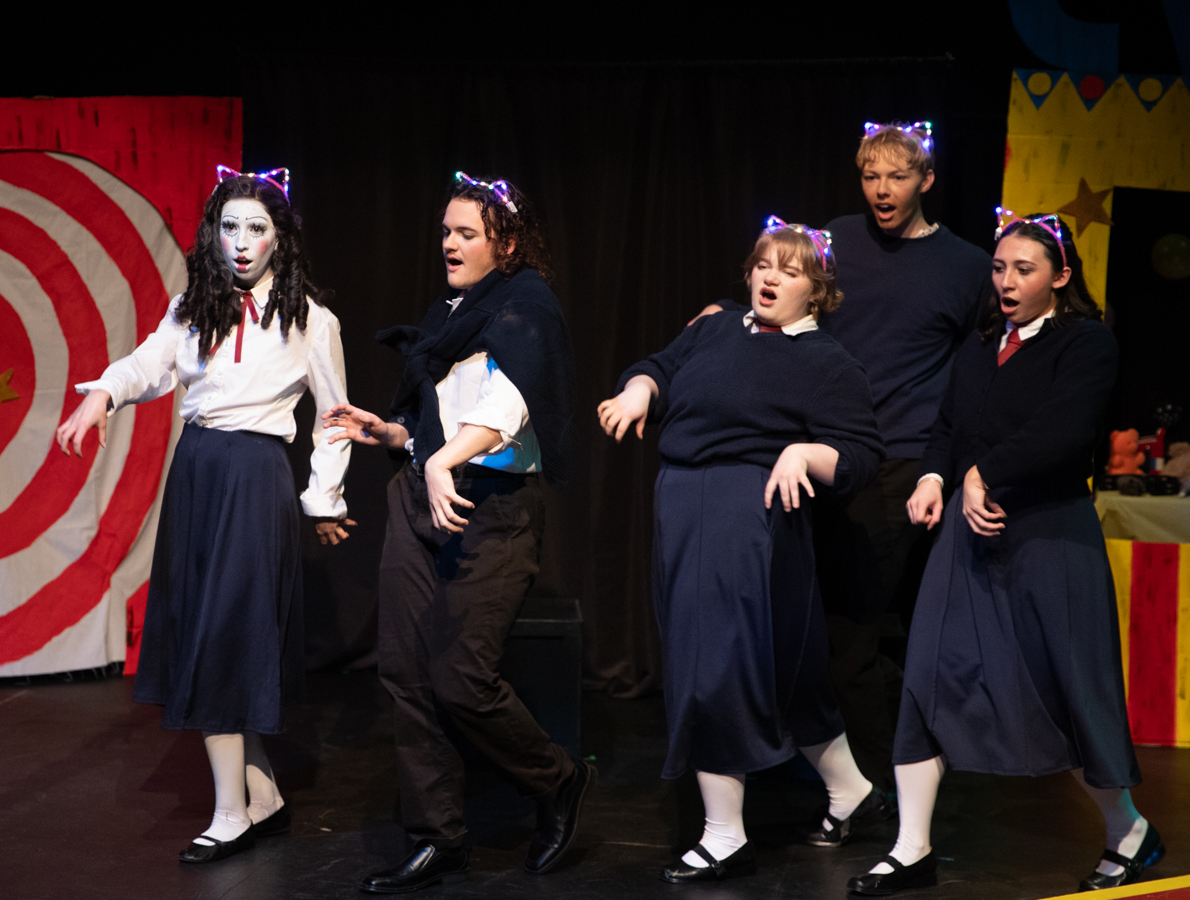
Six dead choir kids. One magical fortune-telling machine. A bass-playing rat named Virgil.
I knew I had to be in the theater for the Wichita State music theatre club’s “Ride the Cyclone” production.
The show follows the spirits of six teenagers who were in their school’s chamber choir, who are summoned to an afterlife warehouse after perishing in a roller coaster accident.
The six teenagers are told that one of them will be resurrected by a fortune-telling matching Karnak (who tells people when they will die), and they have to plead their case to him about why they deserve it.
Karnak himself announces he will die at the hands of the bass-playing rat, Virgil.
As an avid fan of the show, I was very excited to hear that a production would be coming to Wichita State from March 12 – 14 in the Metropolitan Complex on campus.
I found myself on a roller coaster of emotion, experiencing the highs and lows of an afterlife competition with the cast.
This spacing and choreography of the production were well-suited to the black box theater setup, a black square room designed for intimate productions. It made the show feel more intimate and allowed the cast to break the fourth wall and interact directly with the audience.
I think the casting was top-notch, each actor embodied their character, and they were emotionally present the whole time.
I have listened to the original cast album many times. My favorite songs to listen to on the album translated directly to this production.
“Space Age Bachelor Man” is a funky disco-pop and comedic song, easily making its way to my favorite song of the show, on the album and in this production.
When watching the show, that was the song I was looking forward to the most. And, I was blown away.
Connor Harris played the perfect Ricky Potts, the physically disabled and mute character who, in the afterlife, can speak, sing and dance.
His song, “Space Age Bachelor Man,” is Ricky’s contribution to the “come back to life competition” the children find themselves in after the Cyclone accident. In the song, he reveals that he is a prophet from the planet Zolar, where people evolved from cats. The number is his tale of how he saved their planet from total annihilation by Count Dog-u-lous.
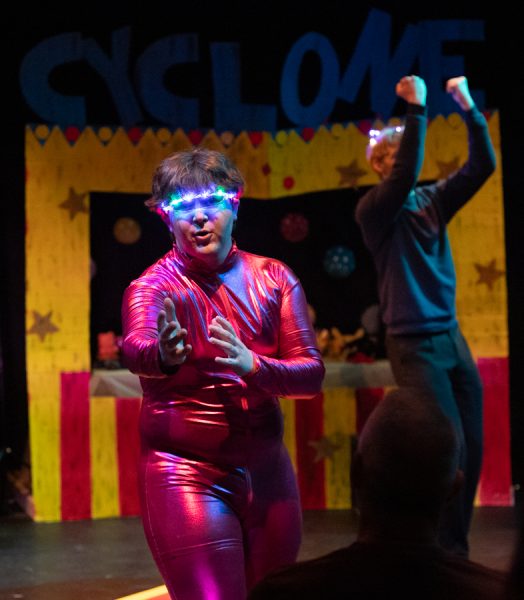
Harris’ performance of this song had me laughing until I cried — he embodied the role perfectly with powerful vocals and some awkwardly endearing choreography.
The most moving performance is a tie between “Talia,” performed by Sebastian McGinty-Kinderknecht, and “The Ballad of Jane Doe,” performed by Aubrey Johnson.
These songs, ironically, sandwich “Space Age Bachelor Man,” which I believe was an intentional move by Jacob Richmond and Brooke Maxwell, the original authors and producers, to create an emotional rollercoaster for the audience.
“Talia” is McGinty-Kinderknecht’s character, Mischa’s ballad to his Ukrainian fiancée, Talia. It is a song of mourning, love lost, and I cry every time I listen to it. McGinty-Kinderknecht poured his soul out into the song; it felt like he was singing to a lost lover.
“The Ballad of Jane Doe” is probably the most well-known song from the show, as it trended as an audio on TikTok a few years ago. It is also the most impressive vocally and emotionally, with operatic high notes paired with some impressive low notes.
Johnson played Jane Doe well; she really sold the doll-like movements and mannerisms of the character.
In the accident, Jane Doe lost her head and had it replaced with her doll’s head. Out of all of the characters, she doesn’t remember who she is. Her solo song, “The Ballad of Jane Doe,” is her begging and pleading with a higher power to remember her past life.
Johnson nailed the song, and I felt the deep-seated longing to know who you are in her performance.
The main qualm I had with this production was the audio.
From what I could tell, the actors weren’t wearing microphones, so they had to project to be heard by the audience.
This is understandable in a black box theater, which is designed to be more intimate. But there were several instances during the show in which the backing music was louder than the actors’ and their lines and performance were lost to the music.
Luckily, I know the show, so I was able to fill in the gaps, but someone who wasn’t familiar would probably be lost.
Overall, I really love this show, so I had an incredible time. I laughed until I cried, and then I cried for real: a true emotional roller coaster just as “Ride the Cyclone” should be.

