The history of the printed word is rarely as clean as the final page.
In Wichita State’s Project Space Gallery, a new exhibition is expanding that record, looking past the machinery of the press to the manual, often overlooked labor that built the industry’s foundation. It isn’t an attack on the traditional narrative, but a recovery mission for the women whose contributions were left in the margins.
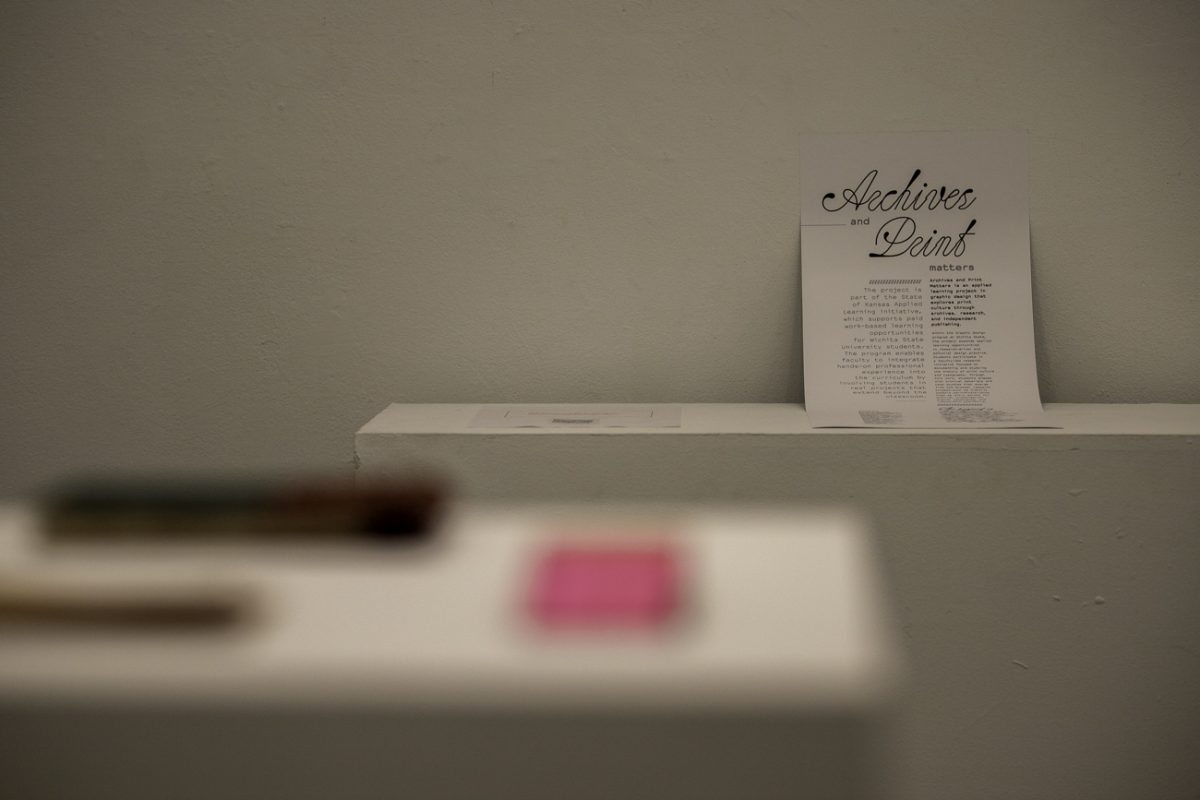
“Building Futures: Printing Women,” which held its opening reception March 13, isn’t just a collection of old papers.
It is a targeted reclamation of women’s agency. Led by Assistant Professor of Graphic Design Irma Puškarević and developed alongside students Megan Ryan and Shelby DuVall, the show dissects how women used “peripheral” print — periodicals, manifestos and ephemera — to build political infrastructure.
From passive research to active agency
For the student designers involved, the project moved beyond typical undergraduate visual research. Puškarević noted that the transition from looking for inspiration to performing archival data analysis was the primary growth moment of the initiative.
“Usually for graphic designers at an undergrad level, research is visual research,” Puškarević said. “But this was data collection, data analysis and then reinterpreting that data … It’s not just an exhibition that illustrates history, it’s an exhibition that examines it.”
The team broke from aesthetic design into the work of historical interpretation.
“Women … were not credited for the work because men were credited because they got to deliver the final product,” Puškarević explained. “But women were documenting, circulating, collecting, distributing—all of that labor actually made printing infrastructure possible.”
The archive of the unacknowledged
DuVall’s research into the British Women’s Land Army and the Women’s Antifascist Front of Yugoslavia revealed a jarring disparity between service and recognition. The WLA was essential to the U.K.’s survival during World War II, yet they remained ghosts in the official record for decades.
“The most interesting thing was the women struggled a lot to get any sort of recognition after the war was over,” DuVall said. “… They weren’t officially recognized by the British government until like 2007 … by then, the girls were dead. So it didn’t matter.”
This 60-year silence underscores the exhibition’s core argument: because women’s work was often transient, it was deemed less worthy of study. DuVall reframed this as a story of “women making cool stuff about these women doing bold, badass stuff.”
Pushing past the ‘typical’
Ryan’s work pulled the 1850s into the present, sifting through periodicals like “The Hesperian” to find a legacy of advocacy. She deconstructed these titles to show they were more than just old magazines — they were a manual social network for justice. She highlighted women editors who spoke for marginalized groups, including Native Americans and African Americans, when those communities were silenced by the state.
To translate these archives for a modern audience, Ryan said she had to abandon the “precise” constraints of modern layout design. She deconstructed physical books and used painting to mirror the “flowy” nature of poetry.
“This was a project where we had to push ourselves,” Ryan said. “We had to go past what we typically do into creativity that we’re not used to. ‘How can I make this more creative versus going basic or typical — what other people are doing? How can I make it just that extra step?’”
The handmade history
The physical toll of the work is visible in the details of the gallery. Some pieces are hand-sewn directly into the paper, a choice that forces you to notice the manual, domestic labor that once kept 19th-century printrooms running. The thread pulling through the page moves the project beyond a standard digital layout, physically documenting a history that was largely built by hand.
By showcasing publications like “The Una,” “The Lily’ and “The Voice of Industry,” — early papers dedicated to women’s rights, sobriety and factory labor reform — the exhibition aims to prove that print was never a neutral medium; it was a political practice.
The exhibition at the McKnight Art Center runs through March 27. Puškarević and her team are also developing a digital platform to ensure these stories of labor and agency remain public.