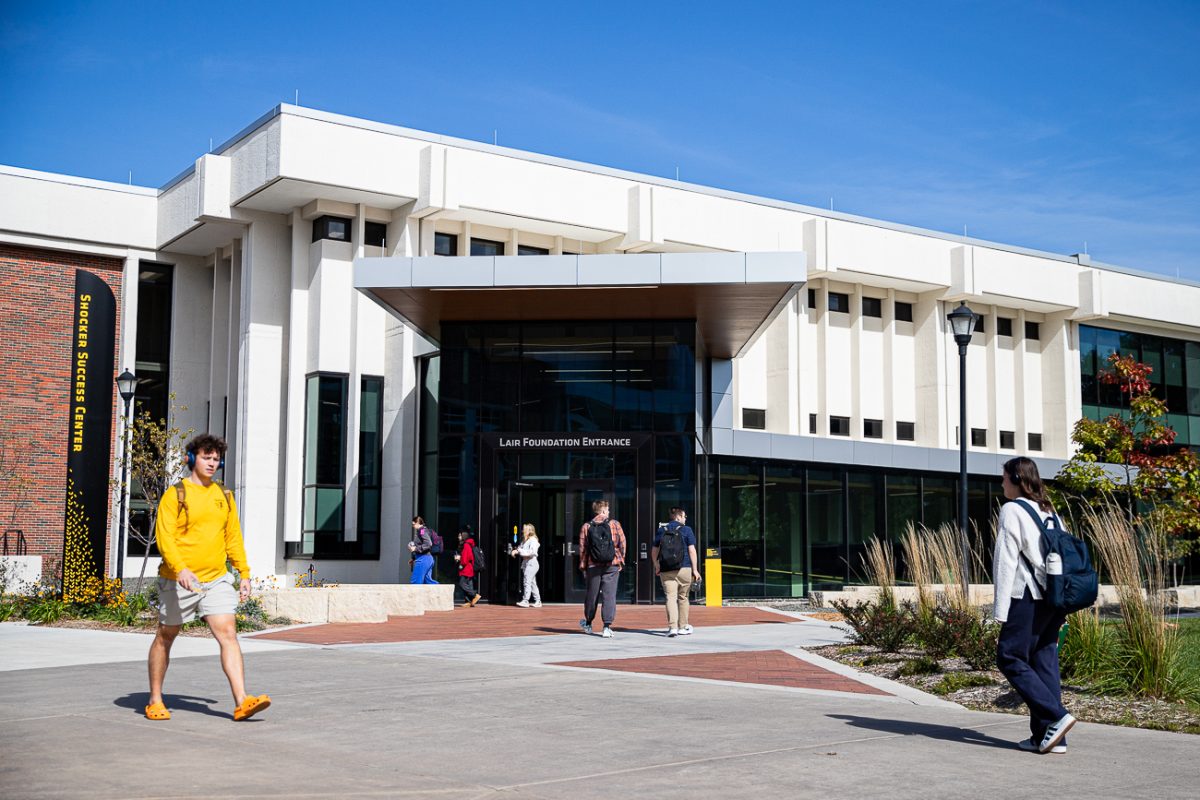
The Kansas Legislature passed its budget for fiscal year 2027 Friday morning. It included a 2.5% cut in base operations funding for the state’s public research universities — including Wichita State — and the elimination of student success funding. It also allows the universities to raise tuition.
Wichita State University was allocated nearly $78.2 million in base operational funding. The University of Kansas was allocated the most, at $160.5 million, and Kansas State followed at $115.3 million.
Zach Gearhart, Wichita State’s director of government relations and chief of staff, said the cuts were about what Wichita State expected.
“Is it great? No,” Gearhart said at the first of two public legislative updates Friday. “Is it better than probably my worst case scenario? Yes, but I don’t think we’re out of the woods for next year.”
Student success funding, which was entirely cut from the budget, previously went to services like advising. Its elimination brings WSU’s total cut to a little under 3.5%, Gearhart said.
The conference committee, which worked to reconcile the House and Senate’s different versions of the budget, also decided not to cap tuition, meaning the universities have the option of raising tuition to offset the cuts.
According to Wichita State’s Chief Financial Officer David Miller, at the Friday afternoon meeting, the university will seek a 4% tuition increase.
University employee pay
Universities under the state’s Board of Regents, which oversees higher education, will receive money to increase pay for employees. The money would be equivalent to 1% of all benefits-eligible employee salaries.
“That doesn’t mean every employee at WSU would necessarily get 1%,” Gearhart said. “That’s only on our state general fund side.”
University leadership, Gearhart said, will have to determine what money is available through other funding, like tuition, and how that factors into a potential pay increase.
Other funding
The budget includes campus renewal funding, which helps the universities address deferred maintenance. Money for campus renewal is distributed by the Board of Regents.
“This was a previous bill that passed, that had multiyear funding,” Gearhart said at Friday’s second update, aimed at students. “But there was talk of cutting that in the budget, but we successfully defended that.”
The budget also retained funding for need-based aid, which goes to universities based on the number of Pell Grant-eligible students at each institution.
WSU got $2 million for its technology transfer facility, which helps people license intellectual property, $5.2 million for aviation infrastructure, $15 million for aviation research, $5 million for business partnerships, and over $4.2 million in aid for students with financial need.
After the conference committee’s report passed both the House and Senate Thursday (with a 23-16 vote in the Senate and 67-53 vote in the House), it was sent to Kansas Governor Laura Kelly for her signature. Kelly can alternatively decide to veto the bill, sending it back for further discussion.