The Kansas Legislature’s budget includes a ban on state higher education institutions requiring courses with diversity, equity and inclusion content for most undergraduate degrees.
In the appropriation bill passed by the Legislature, the budget is not the only content; legislators can also add provisos, policies that create conditions for funding, and pass them with the budget.
The new proviso regarding DEI curriculum adds to language included in the past years, barring DEI policies and initiatives. It would withhold $2 million from Wichita State if the university violated the policy, and be enforced starting in academic year 2028. Kansas Governor Laura Kelly has not yet signed or vetoed the appropriations bill.
Universities have until academic year 2028 to make all the changes that are needed to comply. Schools can apply for exemptions from the Kansas Board of Regents, which oversees higher education in the state, for programs that they think are inseparable from the topics targeted by the legislation.
Two years ago, the Legislature passed Senate Bill 125, banning any DEI activities or programs at state universities. It included banning state employees from having pronouns in email signatures, which Gearhart said WSU interpreted to also include members of student organizations.
SB 125 put restrictions on appropriations for fiscal years 2025, 2026 and 2027. If universities violate the DEI restrictions, funds can be withheld.
However, this year the legislature is allowing the universities to work with KBOR, to interpret what content violates the rule.
“I think there’s a mischaracterization of what, at least, this university does with DEI,” Wichita State’s Chief of Staff Zach Gearhart said at a legislative update on March 27. “I think in the legislature, their interpretation is that DEI is a zero-sum game … that’s not what Wichita State does. What Wichita State does is we want anybody who wants to come to this university, regardless of their personal lived experiences in the background, to be successful.”
Changes are being made at all universities to correct what the legislature found to be in violation. The budget has not passed yet — it has been sent to Gov. Laura Kelly and is waiting on action from her.
Existing anti-DEI policy
In December, the legislature found that every university in Kansas still had DEI-related language in their course catalogs and websites, Gearhart said. The legislature found these violations by running websites and course catalogs through artificial intelligence.
Gearhart said part of the reason for the violations was “a timing issue.”
“We have a strategic plan … and we updated our strategic plan to comply with the previous law,” he said. “The problem is the course catalog gets approved and printed prior to that previous law coming into effect.”
Gearhart said that because this year’s new proviso was passed after the course catalogs came out, there was no way to go back and change it for the coming academic year.
The legislature allowed universities to work with the Kansas Board of Regents to define DEI — which was never defined in previous provisos or bills — and universities have until academic year 2028 to make sure no degree programs require DEI-related classes.
“This is challenging because in one lens you’re going to see that this is more specific, but then you’re also going to see that it is very broad,” Gearhart said. “… programs, activities — that’s very broad, nebulous term that we’re left to interpret.”
But, he said, the language banning university employees from including pronouns in their email signatures “is pretty definitive.”
DEI first became a topic of discussion in the Kansas Legislature three years ago when the House introduced House Bill 2105, which prohibited institutions from hiring or promoting faculty and staff based on factors like race and ethnicity. One of the bill’s provisions said there would be no effect on curriculum or violations of academic freedom.
What needs to change at WSU, and faculty concerns
One of the main concerns that WSU has to deal with regarding DEI in degree requirements are general education requirements.
Because there’s no clear definition for DEI, Gearhart said, “if the word DEI is mentioned, it’s not good.” Gearhart also said that in SB 125, the provision does affect curriculum.
General education requirements are split into seven buckets that are decided by KBOR, each bucket having different requirements. Bucket seven specifically requires three credit hours with diversity content and three credit hours of a first-year seminar.
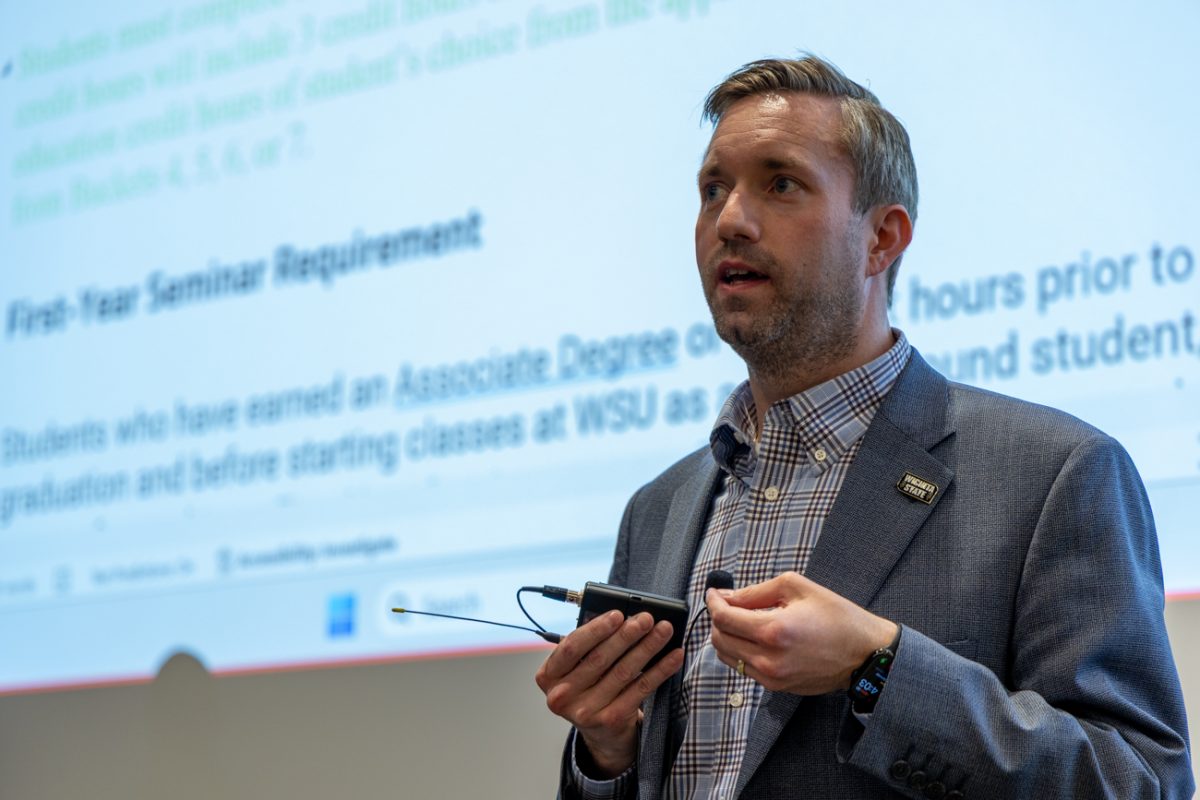
During a general faculty meeting on Monday, faculty voted to approve a change to make bucket seven’s requirements include three credit hours from an approved list of courses in either buckets 4, 5, 6 or 7 with no diversity requirement and the first year seminar requirement.
“What we’re essentially doing is taking the bucket as kind of a catchall where a student can take another class; it doesn’t have any real purpose other than to just fill credit hours,” Faculty Senate president Christopher Stone said during the general faculty meeting.
Many faculty members voiced disagreement with the change, but Stone said academic affairs would have to change the language regardless of how the faculty voted, because failure to make this change would result in $2 million being withheld from the university.
“I will tell you, when I first saw this, whenever we were first introduced, my gut reaction, the first thing I said was, ‘How much money are we talking about? Can we just tell them to shove it?’” Stone said. “And I was quickly told by senior administration we can’t afford to tell them no.”
Faculty gets to vote on this language change because they have shared governance, but Stone said that doesn’t mean they have control over what happens — they just get to participate. Often when changes like this need to happen, the faculty gets to decide how those changes look, he said.
“To students, the greatest threat is a loss of funding,” political science professor Neal Allen said.
Political science professor Carolyn Shaw said prior to the diversity requirement being added to general education, most students were already taking classes with diverse content, even before they got to the point in their general education when it was required.
Stone also said that more major changes to general education requirements could be made in the future — since many faculty members were unhappy with the revisions — and it will be sent to the Faculty Senate’s general education committee in the fall for further review.
“This is obviously a hasty decision, so I would strongly recommend that next year’s senate take on making this better,” associate professor of philosophy Susan Castro said.
The blurry definition of DEI was also a factor in faculty’s reluctance to make this change.
“They say we’re out of compliance,” Chair of the history department George Dehner said.
“But they say ‘give us a definition of DEI by 7/31/26,’ so how can we be out of compliance if we don’t have a definition?”
The way the legislature is handling this year’s budget provisos is a “doozy,” Gearhart said during the faculty meeting, and many faculty members expressed that they feel it is a violation of academic freedom.
Some faculty members didn’t see the risk of pushing back on the legislature as worth it — especially since, according to Shaw, 90% of students were already taking diverse courses without the requirement — but others were still concerned that this would lead to the legislature making changes in curricula and what can be taught at institutions, not just prohibiting DEI in degree requirements.
“So, the impact of students taking the courses is minimal, and yet we’re willing to risk money over this requirement,” aerospace engineering professor Roy Myose said in support of the language change.
Though the language change did pass, this likely won’t be the final change to the general education requirements.
“I’m glad lots of our students take diverse courses, but this is giving up our academic freedom,” Shaw said.