



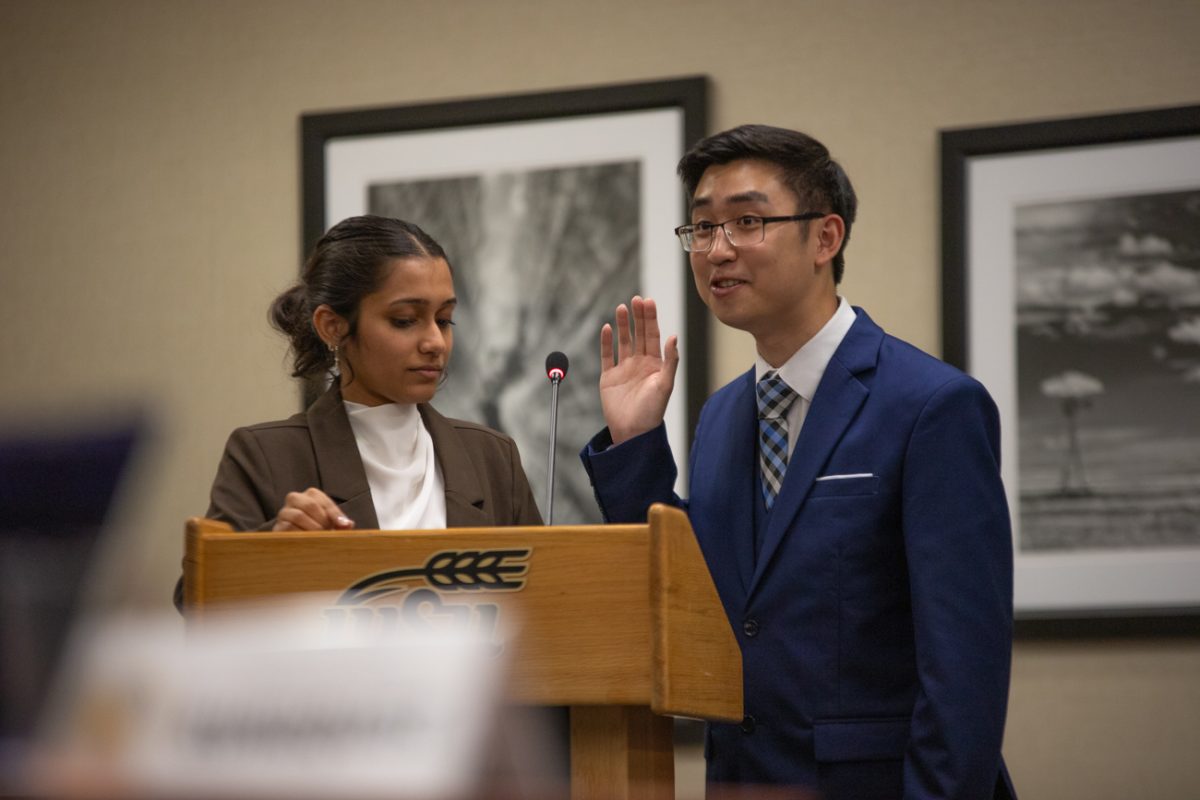
Candidates for the upcoming student body president and vice president elections had their final debate, focusing on topics like student outreach, support for marginalized students and current SGA processes Thursday evening.
Candidates Mason Fouquet and Nazanin Kasirosafar are running against Jayden Island and Anoushka Raju for student body president and vice president. Kasirosafar was not at Thursday’s debate. Fouquet said that she was out of the country on a vacation that was planned before they entered the race.
After the candidates appeared to agree on most issues at the first debate on March 26, they clashed Thursday over how to support students amid state policies against diversity, equity and inclusion initiatives.
Support for minorities
Fouquet said the biggest concern should be to always be in compliance with state and federal law because of the threat of losing funding and the legislation “changes all the time.”
“Specifically with these groups, I think we need to advocate for them as much as anyone else,” Fouquet said. “I think that for me at least, I view that as almost a pointed question, it’s like guys, we are not focusing on the right thing here. Rather than picking out and cherry picking certain groups and saying, ‘How can we help them?’ Let’s think about why we’re all here. We’re all students overall.”
He said all groups should be looked at equally and one shouldn’t be prioritized over another.
Island said it is not enough to assume changes will happen with the legislature; they should be actively engaged with minority groups in order to help them when they need.
“Equality is not the same thing as equity,” Raju said. “Not all of us come into college with the same resources and so providing equal support is not going to bring us all to the same level. By providing equitable support, we’re able to help students who maybe come in with fewer resources or fewer support systems to succeed and ultimately cross the stage at graduation.”
In a rebuttal, Fouquet asked Island to explain in what ways universities may not be set up for Black students, as they mentioned earlier.
“This discussion is so much more than my individual experience as a Black student has been,” Island said. “There are systems set up against me in every single way, but I think that by having connections in the university, in administrators, legislative people and the student body that are willing to advocate for me … who may not be able to speak to my experiences but understand where I’m coming from and can even say that I have a problem … just being able to acknowledge that is something that I hope any person in a leadership position would be able to do.”
Fouquet is the vice president of the Wichita State chapter of Turning Point USA. An audience question asked how he would remain impartial while also being a part of a political organization.
“What I think is that Turning Point USA has not hindered my ability to have impartiality among student leadership in any way, I think it’s actually helped,” Fouquet said. “If you think about what Turning Point USA is and does as an organization, we are a civic group that tries to promote engagement of different thoughts in respectful debate and discussion.”
Island disagreed because of TPUSA’s reputation across the country, pointing to aggressive marketing tactics that target queer and trans students.
“While yes, the organization may not hold the values that many students perceive them to have, it’s still important to recognize the impact you have on students and be able to directly address the concern,” Island said.
Managing student fees
During an interview with The Sunflower, Fouquet and Kasirosafar said that they were unhappy with how student fees were handled this year. An audience question asked why neither of them voiced their concern during the deliberations.
“The budget cuts were too late and too much at once,” Fouquet said. “The funding decisions were made very quickly by the finance commission, obviously … with how late in the evening it was during our senate sessions, the senate didn’t really have a chance to fully digest the numbers and so at the time it felt like it seemed like it would make sense to split the discussion and come back on a different day, but unfortunately that’s not how finance hearings work.”
The senate reviews and debates the student fee budget over the course of two meetings. In the first, senators can suggest and vote on changes to the allocations. In the second, they can only change policy notes written into the bill.
There was about a week between the end of the Student Fees Commission’s deliberations, where it finalized the budget recommendation, and when it brought the budget to the senate. Senators, and the public have access to the recommended budget when it is finalized and the commission’s deliberations are live streamed.
“The arguments were valid, and I think that the unfortunate part was afterward, after this was all put into effect, the student response was what hurt,” Fouquet said. “… I mean, it’s never going to be perfect, students are still going to have things that happen that they don’t agree with, and their funding’s going to get cut. When it may seem OK in the moment, it’s not OK overall. I mean, look at O.J. Simpson, he got off.”
Island said it’s unfortunate that neither Fouquet nor Kasirosafar spoke during the senate meeting because it is a privilege to be able to speak with legislative committees prior to the presentation to the senate. Senators usually receive the final budget from the finance commission days in advance to look over anything that they may not agree with. Also, Island pointed out the opportunities both candidates had to watch the student fees deliberations while they were happening.
“We certainly think that if Fouquet and Kasirosafar had reservations beforehand that those should have been brought to the floor,” Island said.
First 90 days
Fouquet said — if they are elected — the main focus for the pair would be hiring the “right people” for their cabinet, finding people with “Shocker’s first” mentality.
“I don’t want it to be someone who would have a shady history,” Fouquet said about his potential cabinet members. “Who would’ve had any past intention of any wrongdoing.”
Also focusing on platforming SGA to students in order to strengthen student engagement is something Fouquet said is important to initiate if they get elected.
“More than anything, just pushing forth the agenda we’re trying to with our campaign,” Fouquet said. “Making sure everyone understands that they’re the reason that we ran and that’s why we’re here.”
Fouquet said his campaign is different from their opposition because of their lack of experience. Both Fouquet and Kasirosafar have been SGA members for less than one year. He said he feels out of place on campus and hopes to improve the university for everyone.
Island echoed the same sentiment in picking cabinet members and finding competent candidates. They also said upholding transparency and providing students with consistent information about the legislature and anything that happens on campus updates over the summer.
“I think also having students who are able to show that passion and connection for students at the university,” Island said. “It’s incredibly important to us that, of course, students feel as if our directors and cabinet positions are people that they can see themselves represented within.”
Raju said the quality and amount of engagement their campaign has had with students sets them apart from the opposing ballot. This is also Raju’s first year in SGA, and she said she has been able to build connections with people on campus.
Combating student issues on campus
When asked about complaints from students and how SGA would work to fix the problem, Fouquet said that he hears a lot of students talk about food quality on campus.
“I’ve heard complaints of soggy chicken from Chick-fil-A, I’ve heard complaints of hard, rock-hard rice from Panda Express,” Fouquet said. “And while that may seem like a minor thing, I think that at the core of what we’re doing here, you know, it’s in our campaign, we want to advocate for students.”
Island said the biggest concern they’ve heard about from students is parking. Because of the complexity of the issue, one suggestion for helping the problem Island brought up was building strong relationships with parking services.
“I think having strong relationships with those offices and sitting down with parking services to see what can we do in our capacity as student government officials to help guide those conversations forward,” Island said. “Even provide more information about parking services to students to really build that gap in communication.”
“If elected, we plan to lead by making SGA more open and approachable,” Fouquet said. “That means sharing information about budgets, policies and initiatives early so students can provide input before decisions are made.”
Raju said that she and Island are focused on connecting with students and making sure everyone feels like they have a place on campus.
“Those conversations remind us that while Wichita State is strong, there is still work to do,” Raju said.
Fouquet described his campaign as “motivated.” Island said they consider their campaign “driven” and Raju describes it as “fun.”
When asked about their oppositions, Fouquet said that he and Kasirosafar had had multiple conversations about how the other candidates are “passionate.” Island said they noticed their opponents “drive to stay engaged on issues that matter to our students.”
Voting begins on April 6 at 8 a.m. and ends on April 8 at 5 p.m. Students can vote online, through an email that will be sent to them, or at various in-person locations. Students can vote in-person April 6 and 7 from 5:30 p.m. to 7 p.m. at the Shocker Dining Hall and April 8 from 12 p.m. to 2 p.m. in the Rhatigan Student Center.


Hamilton • Apr 4, 2026 at 10:40 pm
For the editor, writers, and those referring to them, Presidential candidate Jayden Island uses they/them pronouns.