


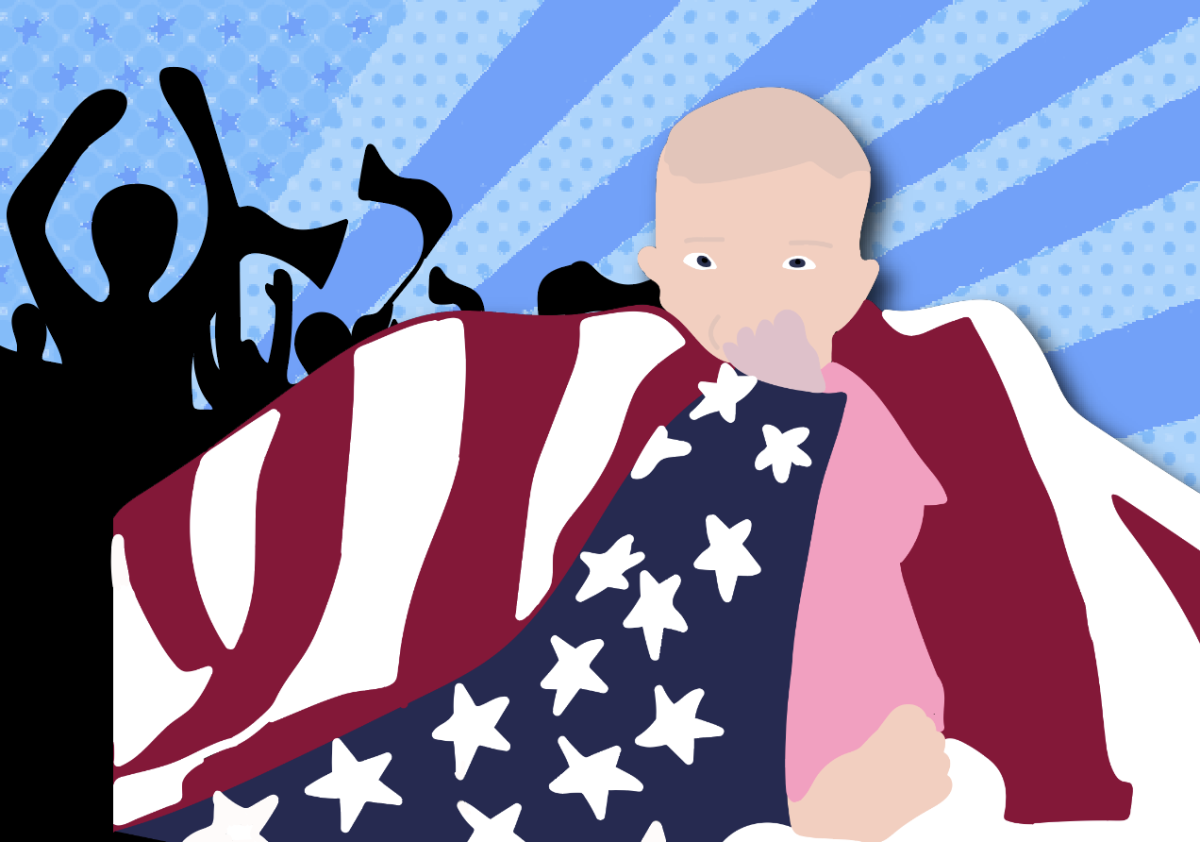
President Donald Trump is attempting to end over 150 years of constitutional law protecting birthright citizenship, with the stroke of a pen — or sharpie.
Birthright citizenship is protected by the 14th amendment, which was passed to rectify the 1857 Dred Scott v. Sanford Supreme Court decision.
In Dred Scott, the court decided that the U.S. Constitution did not allow people of African descent to gain citizenship. This is cited as a triggering event that led to the civil war.
The 14th amendment’s citizenship clause established birthright citizenship by stating, “All persons born or naturalized in the United States, and subject to the jurisdiction thereof, are citizens of the United States and the State wherein they reside.”
Trump signed an executive order, Protecting the Meaning and Value of American Citizenship, on Jan. 20, 2025. The order would prevent citizenship by birth for children based on their parents legal status.
The problem is the president does not have the authority to invalidate constitutional amendments through executive order, and the legal arguments backing the order have no basis to stand on.
If a president could do this, what’s stopping them from taking away women’s right to vote, ending free speech or changing how long they can be president?
Trump’s three main arguments for ending birthright citizenship are stopping birth tourism, parents’ immigration status affecting birthright citizenship eligibility, and claiming the 14th amendment only applies to formerly enslaved people.
One can only guess that the president lacks the basic ability to use Google, because that is all it takes to undermine each of these positions.
Trump’s administration argues birth tourism incentivizes mothers without legal status to give birth in the U.S., so their children gain citizenship. At the very end of his first term, he attempted to address this by changing visa rules.
Because this is so important to Trump’s position on birthright citizenship, it must be a major issue… right?
According to the CDC, about 3.6 million babies are born in the U.S. per year. What’s the worrying number of babies born to mothers without legal status? It’s around 9,000 or 0.25% of total births. To put it another way, it makes up less than half of the number of students enrolled at WSU this last fall. Not exactly the pressing issue that Trump and other officials make it out to be.
Even when looking at numbers of births from mothers designated as temporary visitors, those only made up 2% of all births reported in 2023.
On the contrary, a friend of the court brief, filed by 141 professors opposing the executive order, says 255,000 babies per year would be negatively impacted.
Solicitor General John Sauer argued that parents’ legal residency can affect birthright citizenship eligibility, despite that never being the case.
The Supreme Court case US v. Wong Kim Ark affirmed that being born on U.S. soil superseded other exclusions to citizenship. Wong Kim Ark was born to Chinese immigrant parents, when the Chinese Exclusion Act barred them from becoming naturalized citizens. The Court found that Wong being born in the U.S. exempted him from the Chinese Exclusion Act and affirmed the 14th amendment’s citizenship clause.
Sauer’s logic says Wong gained birthright citizenship, because his parents treated the U.S as. a permanent home and not from being born on U.S. soil.
Nearly all Supreme Court justices seemed skeptical of this premise, including Trump appointed Justice Neil Gorsuch who cited 19th century debates over the 14th amendment.
“In none of the debates do we have parents discussed,” Gorsuch said. “And you don’t see domicile mentioned in the debates. The absence is striking.”
Claims that the 14th amendment was meant only for formerly enslaved people focuses on the phrasing “subject to the jurisdiction thereof.” Trump’s administration believes this phrasing creates exclusion for parents that live in the U.S. illegally.
Cecilia Wang, legal director of the American Civil Liberties Union, argued that legal focus should stay on the newborn.
“The question that the 14th amendment asks is whether the U.S.-born child is subject to U.S. jurisdiction when they’re born,” Wang said.
The reality is the Trump administration does not care how it would work out for newborn children or their families.
A report from the Migration Policy Institute should removing birthright citizenship would weaken social cohesion, hinder economic growth and mobility, and build an underclass that cannot access necessary services.
It will also hinder anyone wanting to go to college. Plyer v. Doe established that denying children access to K-12 education violated the 14th amendment, but this does not extend to universities.
Undocumented students cannot access federal financing options like student loans or Pell Grants. The Kansas legislature has passed Senate Bill 254 to bar undocumented students from being eligible for in-state tuition. The bill was vetoed by Governor Laura Kelly.
Regardless of any points made on historical facts, legislative intent, or any other justification, the bottom-line is this is a cruel and unnecessary action. It provides no benefit other than Deputy Chief of Staff Stephen Miller, — who leads Trump’s immigration policy — having his blatantly racist viewpoints validated.
When the president’s immigration policy is in the hands of someone who gave a public speech echoing statements made by officials in Nazi Germany, you know it has gone way too far.





Anonymous • Apr 15, 2026 at 8:29 pm
No they don’t birth right citizen ship is a relatively novel concept and it was mostly used for freed slaves not immigrants that are jot aware of how western culture operates.