


I think it’s important to start by noting that you won’t usually find my name in the opinion section. In general, I find a lot more value in sharing information than adding my opinion to the deluge of voices that make up public discourse.
And this isn’t a column where I tell you how to vote, what to think or to call your congressperson. Instead, I just want to give you some food for thought. And I want to hear back from you.
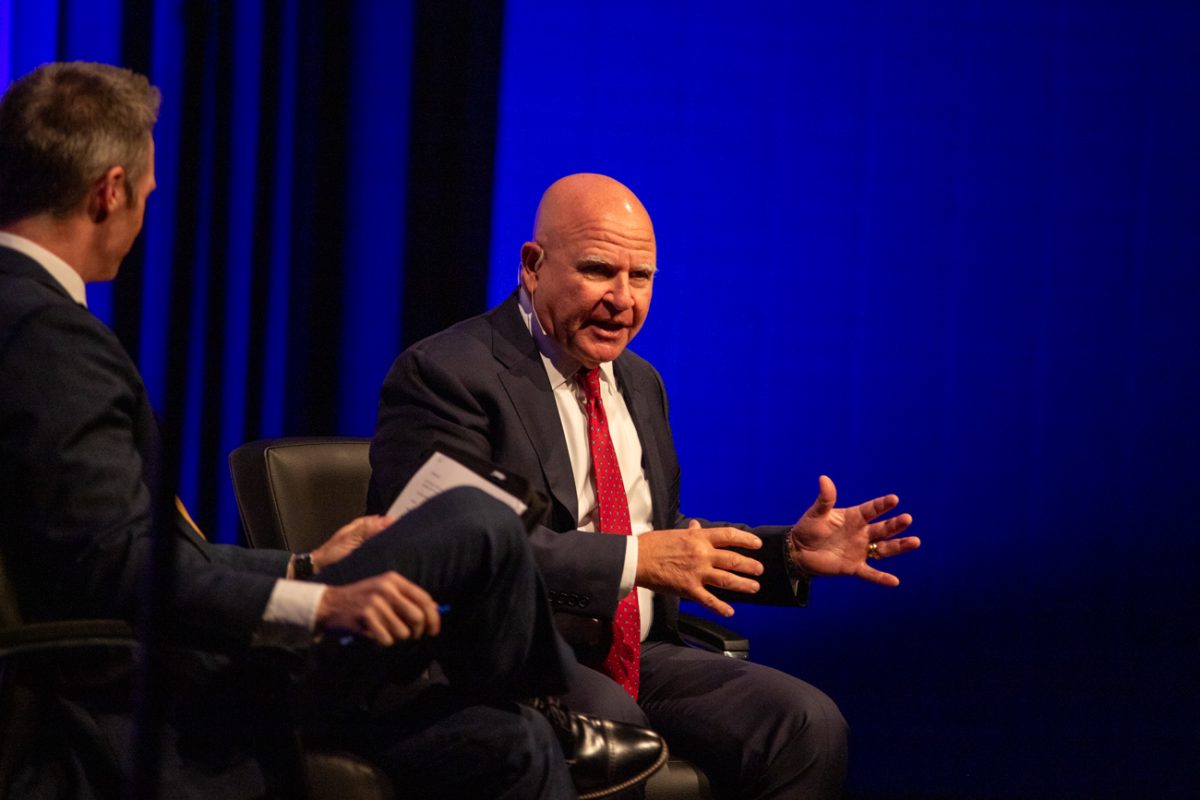
On Thursday, I went to cover a speaker on campus: H.R. McMaster, a retired Army lieutenant general and former national security adviser, who was here as part of the annual Craig W. Barton Speaker Series.
McMaster, whether you agree or disagree with him, is clearly an expert on his subject matter. He was fighting in Iraq before I was born, and again while I was learning to read and ride my bike. He talked about his perspective on the war with Iran, the communication coming out of the White House and what concerns — and hope — he has for my generation.
As I left the event and then started writing my story, I felt for the first time ever that my voice might actually add something here. Or rather, maybe it was just an urge to speak to you directly for once. You. Reading this in the Rhatigan Student Center, waiting for your friends, or maybe clicking on a headline on your social media feed.
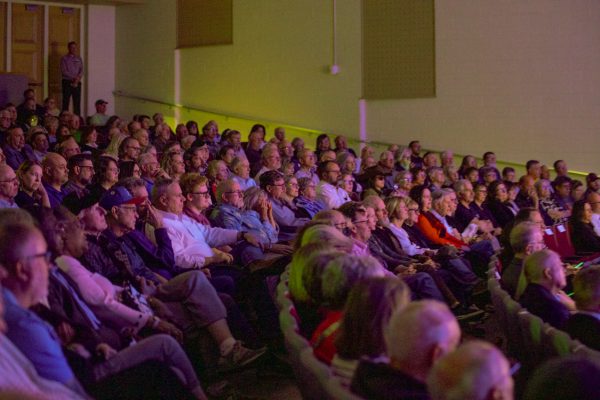
One big reason for this was that, as I stood up when the event ended and scanned the crowd for audience members who looked like they would answer my questions and share their thoughts on what McMaster said, I noticed a stark lack of people under 30. Actually, I struggled to find people under 50.
I usually prioritize talking to students or a mix of younger and older people. It’s you I write news for, so I feel it’s important to get your perspective — and most of you are around my age.
It was particularly an issue that weighed on my mind because McMaster — in addition to expressing his support for the war and lamenting the lack of transparent, consistent messaging from our government about it — talked briefly about the lack of trust people, particularly the average college-aged person, have in institutions like news organizations and government.
KSN’s Jeff Herndon, who was moderating the event, asked McMaster what gives him hope for the next generation (that’s us guys!) and what worries him. Here’s some of what McMaster had to say:
“I think a lot of the younger generation now, too, are understanding better the dangers associated with social media and the dangers associated with this phenomenon today — that we are better connected with one another than ever electronically, and more distant from one another than ever emotionally, psychologically, socially, spiritually.
“And I think there is a hunger for that … and a desire to be more empathetic with one another. So I see that, and that gives me faith and confidence.”
But earlier in the conversation, in response to a question from Herndon about polarization in America, McMaster talked about what he called a “crisis of confidence.”
“What I’m worried most about these days is the erosion of our confidence and our democratic principles and institutions and processes,” McMaster said.
He went on to list various events and shifts that contributed toward this, and to tie this lack of confidence to President Donald Trump’s political success — not a new idea.
“There’s a lot of good reasons for that kind of disappointment,” he said.
Then he said what really got me thinking: “I would add onto that as well, kind of the dominance of the academy of — and I’m going to state this straight up — what I would call an orthodoxy of self-loathing.
“I’m sure not here at Wichita State, but in some humanities departments, what used to be an interpretation of U.S. history, kind of the postmodernist, postcolonial, new left or Marxist approach to history, became dominant. And I think many of our young Americans were taught that their country’s not worth defending.
“…And the effect I think that has is it robs them of agency. It leaves our young people, particularly, only this toxic combination of anger and resignation.”
The idea of an orthodoxy of critical, maybe even Marxist theory, dominating the liberal arts isn’t new. It’s a source of struggle, and of political change, particularly in our state. But I’ll leave that alone — I cover that, after all. Really, what I left this event wanting to know was: Is there really a crisis of confidence among my peers? How does this influence their views, their outlook on life?
My instinct was that yes, this is very real. I don’t even think I need to explain. You know it too.
The day after the event, I wanted to talk to students about this. I asked questions like: “Do you trust institutions, like news organizations or government?” “What do you think about the Iran war and other geopolitical events?” “And how are these two connected?”
And of course, “Is there hope?”
Here’s what I found.
Ramey Anderson and Madelyn Schick were eating lunch in the RSC on Thursday when I asked if they would answer some questions about these topics. The answer was an enthusiastic yes.
When I asked how much faith they had in information from media and government, Anderson, a cybersecurity major, said: “I have absolutely none.”
“There is so much information that has been hidden from us that you have to go seek out it’s not public information,” Anderson said. “You have to go digging for it.”
Schick, a political science major, also expressed doubt about how trustworthy the news is.
“With international news right now, a lot of things are being reported in other countries about (the U.S.) about us that we don’t know about,” she said. “There are so many U.S. citizens that don’t actually know about all the details going on with Iran and Israel and everything that’s going on with prices economically, and then also with international relations and all that.”
Schick added, “I think another issue that we have with trusting media is also just the lack of media awareness. Like a lot of people don’t know how to navigate the news, and they don’t know how to find trusted and reputable sources.”
While they said there is a lot of reason to distrust news sources, they both listed a few national and local news outlets — like KWCH and KAKE – that they get information from, and emphasized the importance of checking multiple sources.
Anderson said she didn’t support the war with Iran, but that “some aspects are necessary.”
“It’s been going on since before I was born,” she said. “Sign a treaty. There’s other ways to figure it out, other than nuking each other into nonexistence, like Trump had tweeted out the other day — which was insane, that ‘an entire civilization will die tonight’ and ‘never to return again.’”
Another student in the RSC, Preston Cyrier, expressed slightly more trust in information from news organizations and government sources. And while he said he gets some of his news from social media, he also emphasized doing your homework before believing information.
“The Associated Press, I like that it’s pretty unbiased,” he said. “I also trust the government generally, but I still like to check if I can. And I don’t believe everything they say, cause some of it’s a little crazy.”
So that’s what a few of our peers think when it comes to trusting institutions, following the news and checking information. I’ll admit, I expected to find one or two people who said they get their information mostly from social media. I was happily surprised to find that students have a good understanding of reasonable doubt about information they see, and the importance of doing research and checking multiple sources. But I’d also like to hear from you: do you trust the news? The government? Have they given you a reason to?


Aaron • Apr 17, 2026 at 8:22 am
Honestly, I find it interesting and/or ironic that McMaster’s argument about young people not trusting government and media mystifyingly overlooks who is responsible for that public mistrust–namely the people McMaster has worked for and politically aligns with. I am not arguing that the Democratic Party is blameless, but the Republican Party and American conservatives have reliably worn away at public institutions, public trust, and quality journalism for decades. McMaster and likely the majority of the people who attended his talk are pointing fingers in the wrong direction. It isn’t the fault of young people, of honest media, and of sincere government employees–we are living with the consequences of a dismantling of American institutions for the profit of relatively few people and in the service of a broken ideology of rugged individualism and greed.
Eric • Apr 11, 2026 at 7:17 pm
I have absolutely no reason to trust the government. Things that come to light after documents are released often don’t match the messages from the government at the time. History has shown the U.S. government has committed horrific crimes against its own citizens, such as the Tuskegee experiments, which ran 4 decades into the 1970s misleading citizens and giving them STDs.