


Editor’s note: This story has been updated to accurately reflect the theme of this year’s Pride Prom, “Masquerade,” and the current titles of Spectrum members.
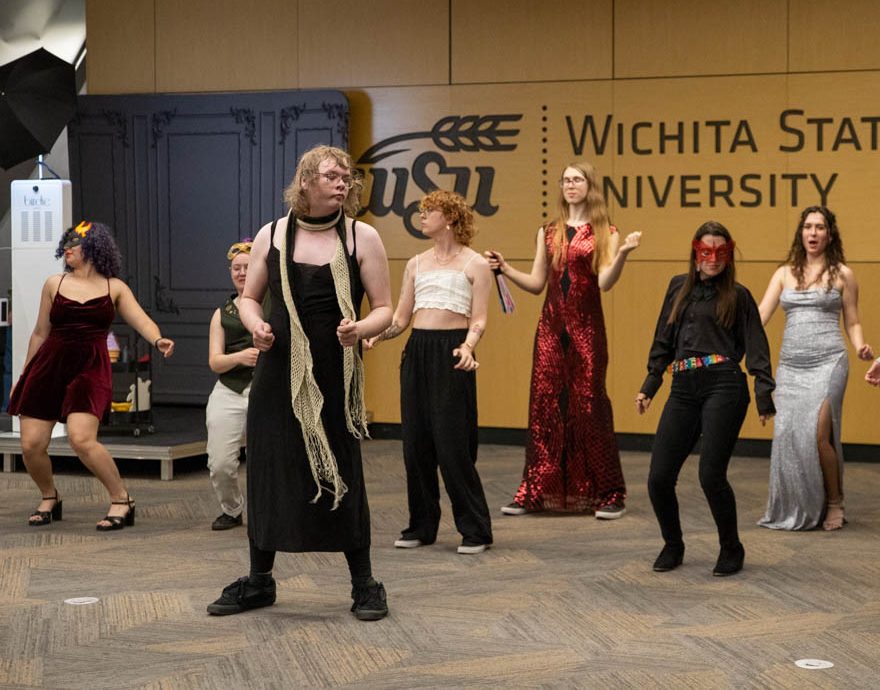
Students donned masks and fantastical attire to dance and chat with friends at Spectrum’s annual Pride Prom on April 18. This year’s theme was “Masquerade,” and the dance was held in the Fidelity Bank ballroom in Woolsey Hall.
Spectrum is an organization for LGBTQ students and allies at Wichita State. It holds the dance for anyone to eat, dance and celebrate “queer and trans love and joy,” according to the event description.
“It’s a fun event, everyone likes fun events,” said Spectrum Treasurer Tauren Engle, a WSU student studying mechanical engineering. “There aren’t many spaces like this.”
Spectrum began planning for the prom at the start of the semester, with a committee of executive board and general members working to organize it.
“I would say it’s fairly straightforward, but … my brain works really well with event planning,” said Moe Hatfield, Spectrum’s secretary and interim vice president. “The most difficult part is when you really have to make a decision, and there’s just too many opinions from everyone on the committee, like deciding (the) theme.”
Hatfield said the number of people who attend the events depends on the overlap with other events and how well-advertised they are.
“Last year, we got somewhere between 60 to 70 people,” Hatfield said.
Despite recent restrictions on diversity, equity and inclusion initiatives at public universities, Spectrum still held the Pride Prom as a way to create a space for LGBTQ students and allies to celebrate joy.
The Student Government Association recently changed how Spectrum and other organizations are classified and receive funding.
Spectrum used to be an SGA agency, funded directly from the student body president’s budget with staff support from the Office of Student Engagement and Belonging. This model was dissolved due to conflicts with state DEI policy after the Kansas State Finance Council designated student governments quasi-governmental, meaning they must follow state regulations like the ones eliminating DEI.
Now, Spectrum and other agencies are considered student organizations, getting their funding from a different pool. The change in designation means the agencies are no longer part of SGA and don’t have to follow state regulations.
With these recent shifts, Hatfield said not much has changed for Spectrum operationally, just a reclassification from being an agency to a recognized student organization.
“That has had both positives and negatives,” they said. “The biggest internal change is that we no longer have to have an adviser that works in the Student Engagement and Belonging office. Since we’re not connected to any university office, we have more freedom in some of the stuff we can do, previously because of our connections … (we were) limited on some of the things we could be outwardly vocal about.
“We’re able to be more open about things as an organization and not just as individual students.”
Hatfield said they and others wished the university would be more vocal about the operational and organizational changes that are being made.
Despite uncertainties about the changes at the university, state and federal levels, Spectrum still aims to fulfill its mission of inclusivity and creating a safe space for LGBTQ students to exist, members said.
“A lot of people try to make those spaces, but it can get difficult sometimes,” Engle said. “The community tries (its) best to make these sorts of spaces for everyone.”
Engle felt like it was a “nice place for queer and allies to come out and have fun.”
Hatfield said next year is the 50th anniversary of having a queer and trans organization on campus, and so the group has begun planning to celebrate that milestone.

