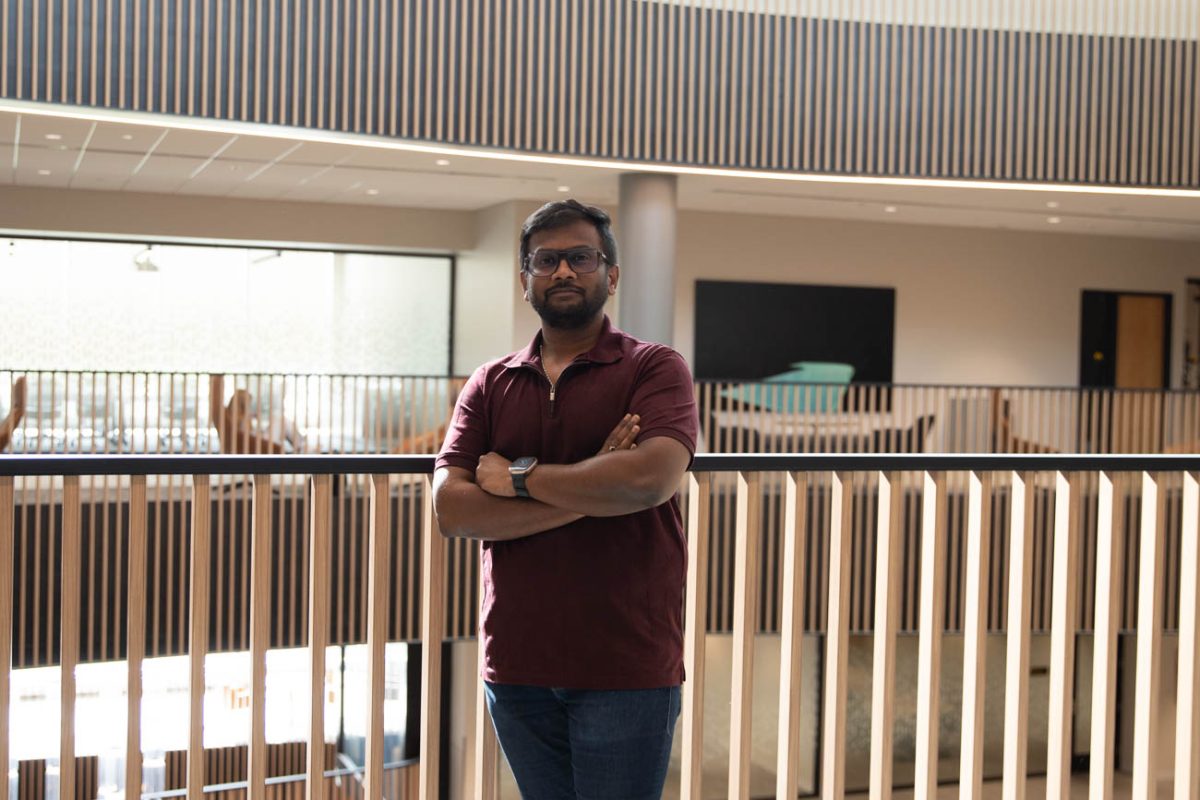
Anil Babu Adhapaka has been busy. During his time at WSU, he’s been a graduate teaching assistant while working on his master’s, and recently he prepared students to compete in a business software competition.
He has his days planned to a T.
For much of the last year, he was working at the National Institute for Aviation Research for six hours a day, then spending a few hours planning for the competition and hitting the gym before teaching an evening class. It’s a schedule that would make many people’s heads spin, but not Adhapaka.
“It’s organization,” he said. “Because if I miss somewhere here — If I’m late at 12:30, I’ll be late everywhere. So I have to make my food plan. I have to make my classes. I can’t miss or skip my gym.”
Mehmet Barut, the director of the Supply Chain Management program and chair of Finance, Real Estate and Decision Science at the Barton School of Business, put it best: “he’s dedicated.”
“He’s a great personality to work with, and he is willing to help,” Barut said. “That’s one of the important things, his willingness to help.”
Adhapaka has a background in mechanical design engineering, working for more than 12 years in engineering, manufacturing and supply chain management after completing his bachelor’s degree in India.
Despite his career in India, Adhapaka wanted to go further. And that’s what led him to Wichita State for his graduate degree.
“I’m always a kind of person to think out of the box,” Adhapaka said. “So that’s where I expressed my interest to my family, that I just want a little more expertise in supply chain —I want to get more hands-on experience and knowledge on supply chain.
“I want some good, higher career growth where I can be confident in automation because the current market was very volatile. With one skill set, it’s very tough to survive in the market, so I have to be such a candidate that every organization should look (for). I want to be an example.”
Adhapaka left behind a wife and three-year-old son in India to study in America, and despite his busy daily schedule, he still finds time to call home.
“It’s very tough, but … in the future, (my son) may take me as an example,” he said. “Luckily, I have good family support, and they’ve encouraged me, ‘Okay, do whatever. We’ll be back behind you.’”
Preparing students for the competition
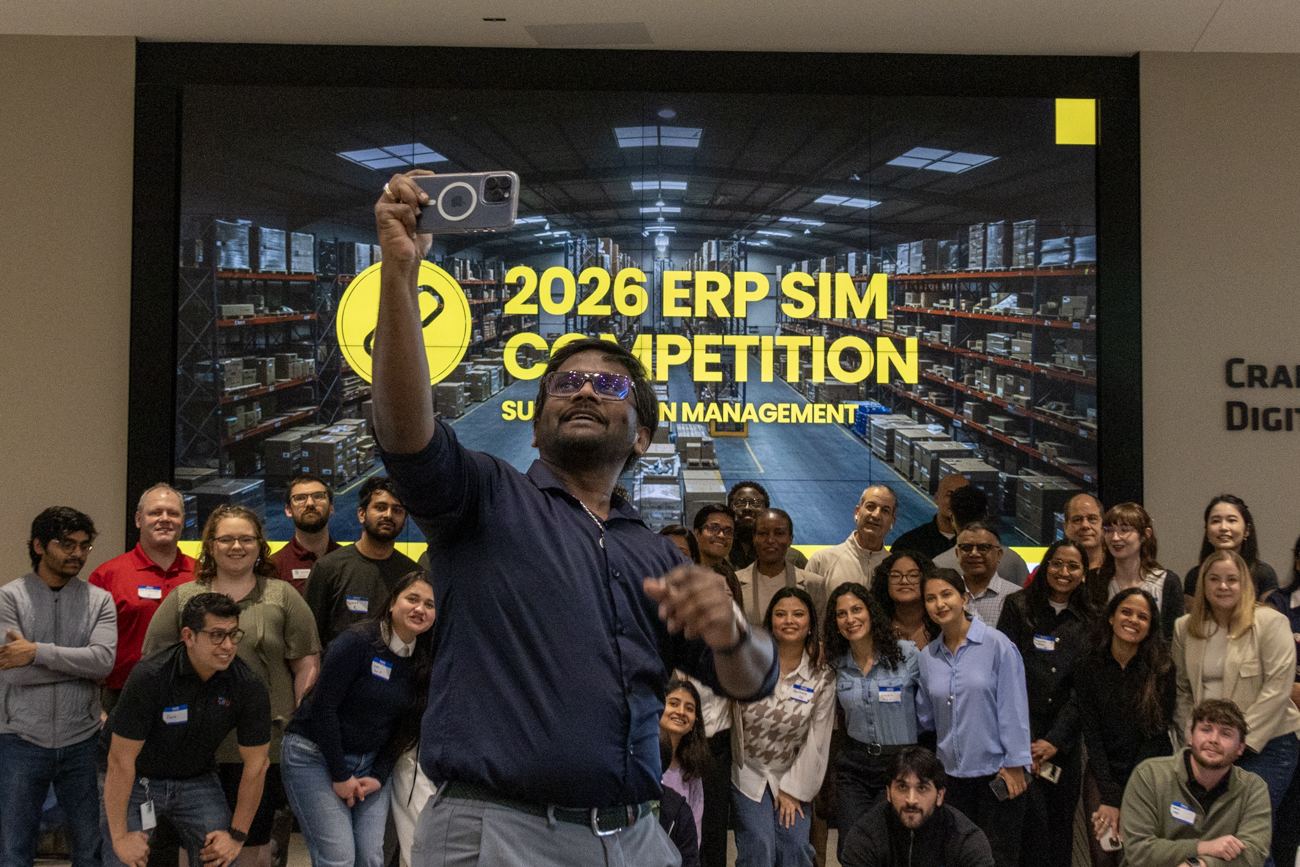
In February, Wichita State students participated for the first time in the ERPsim competition. Adhapaka was instrumental in getting the students ready to showcase their business skills.
ERP, or enterprise resource planning software, is used by businesses to manage processes in one integrated system. In the competition, students are challenged to manage a fictional business, analyzing data and making decisions to keep the company sustainable.
Adhapaka and Barut, with help from Assistant Professor NaRea Cho, spent over a year planning for the contest. Adhapaka went through certification to lead the competition at WSU, then worked to familiarize students with ERP through multiple weekly practice sessions and ensured everything ran smoothly on competition day.
Elizabeth Martinez Bojorquez, a freshman studying international business, was part of WSU’s winning team. She described the work it took to prepare for the competition.
“When we were practicing, we were just practicing individually,” she said. “And then eventually came the part to where, like, ‘Oh, you gotta team up.’ And I didn’t really know anyone there, so I just started asking a bunch of girls around me, and we agreed to team up.”
Martinez Bojorquez ended up in a group of four and said the team felt prepared. But when the day of the competition came, only three showed up, putting her team at a disadvantage compared to some of the others. Luckily, she said she had seen what the fourth group member did in practice and was able to complete his part of the work.
With guidance from industry professionals who help the teams in the competition, they were able to pull off the win.
“Thankfully, when we were teamed up with our two Textron people, they were able to guide us on what you want to do when it comes to real-world activities and how you just want to push it,” Martinez Bojorquez said. “And I think that’s what helped us maintain our profit in the millions. … shockingly, that’s what led to our success.”
Martinez Bojorquez explained how Adhapaka’s guidance helped the students grasp what was, for many of them, an unfamiliar concept.
“A lot of us didn’t really know what was going on either, whether they were in their graduate or undergrad,” she said. “But he was very direct, so it kind of helped us pick it up faster. … And he did well checking up on us, which kind of gave me a relief, because I guess I was a little insecure on the fact of like, maybe, you know, I’m an undergrad, he’d think I’d be asking stupid questions. However, that was not the case at all.”
“The practicing and the coaching during this time was very — I was very grateful for it, because you don’t see people willing to actually take the time to (say) ‘Okay, let me show you how to do this.’”
Martinez Bojorquez said the ERPsim competition was “a great experience.”
“I feel like I’m a very hands-on person, and instead of waiting my time to learn about ERP or SAP through a class or through an internship, I was able to just do that in competition. And I was really happy to see the outcome of us winning first place, because I really didn’t think that was going to happen, and it gave me a sense of gratitude,” she said.
For Adhapaka, the competition was a learning experience, too. For one, he’s used to teaching graduate students, but students of all levels participated in ERPsim, as well as students across multiple disciplines.
“I have to explain (to) undergrad students a little more, deeper, complete process,” he said. “Because it’s a very initial stage of their career – their studies. And luckily, the undergrad students also, they catch up very quickly. I really appreciated the undergrad students.”
Adhapaka and Barut said the competition was a success. While the winning team didn’t place in the national competition, they want to make ERPsim a tradition at WSU and continue to improve WSU’s performance.
“Even for the next year, (Adhapaka is) not going to be a student, he said that he can come and help,” Barut said. “So that’s something that shows how he’s connected, how he’s dedicated too, and how he liked it. Because to do this one, he had to go through the certification with the ERP sim, and he did the first step and the second step. Now he’s motivated to (take) the third step, which is really (a) kind of training the trainers kind of things. So he’s going that direction, which is getting him kind of a confidence as well.

“So I can see that in him, that’s how he evolved from the beginning, the little bit – kind of shyness levels, but now he’s totally gained the confidence through this game.”
With Adhapaka’s time at WSU coming to an end, he said he’s grateful for how supportive the faculty have been. He plans to reenter his industry with more versatile, expanded expertise. And his proudest accomplishment isn’t that he successfully led the first ERPsim competition at Wichita State, or even that he balanced that workload with his own classes and teaching.
“I can say that I earned the trust of students as well as the faculty,” he said. “That’s why they’ve given me this opportunity, and that’s why the students … listen to what I’m saying.”
Now Adhapaka will walk across the graduation stage, with his wife and son in the crowd, and know that he has earned that trust.