Presenting 20 images with only 20 seconds to talk about each isn’t easy.
Faculty from Wichita State’s Art, Design and Creative Industries department did so successfully in the second event of the “Symbols of Greatness: Restoring Truth and Sanity to American History” series hosted in the Ulrich Museum of Art.
The theme and name of the series comes from Executive Order 14253, which was designed to “target improper partisan ideologies,” and it overall serves as a way for the ADCI faculty members to showcase what they are working on outside of education.
Ted Adler, Robert Bubp, Marco Hernandez, Meghan Miller, Jennifer Ray, Lori Santos and Tim Stone each gave presentations with 20 images throughout the night.
“This evening brings together an extraordinary group of faculty, artists, scholars and thinkers whose work challenges, refrains and expands how they understand the symbols that shape our American identity,” said Brenda Lichman, the associate director of education at the Ulrich.
‘Filtered into my thinking’
Robert Bubp, a professor of painting and drawing, said his talk was an overview of the last few years.
His images were a collection of pictures and videos that he took himself and some that he borrowed from social media, during the COVID-19 pandemic and the Black Lives Matter protests of 2020.
“It really made me think about the kind of trauma (of) being forced to be in one place, and also the safety and comfort of Midwestern suburban existence,” he said. “I thought it was interesting to actually see the news from social media as a lens and a way to actually access the news itself.”
Part of his project was to create a mapping series of people he knew that were participating in George Floyd protests across the country and world, including Italy, New York and Georgia. Part of the mapping series has been transformed into an installation at the Advanced Learning Library in downtown Wichita, and is a commentary on redlining and race relations in Wichita.
How identity shaped artwork
Marco Hernandez, assistant teaching professor of print media, focused his talk on how his identity as a Mexican-American shaped his artwork.
After his father died when he was 3, Hernandez, his mother and siblings immigrated to the United States and had to learn to navigate a new culture and language.
“Through persistence and determination, we learned how to navigate life in the United States, and gradually felt a sense of stability,” he said. “Although I was raised in the United States, my family instilled in me a deep pride in my heritage.”
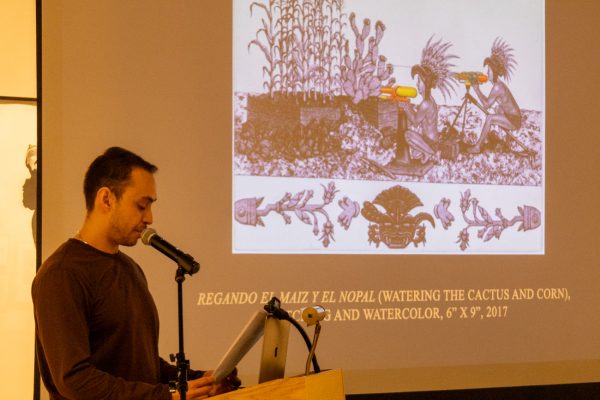
Hernandez said he exists between the two cultures, and his work often incorporates Mexican historical imagery.
“The process of making this work continually pushes me to learn through research and lived experiences,” he said. “Some of my artwork presents these elements in a direct, serious manner and other work includes imagery that is subtle and satirical.”
Only recently has Hernandez been able to return to Mexico, and he said revisiting has inspired him to redefine his connection to his culture.
“This connection has been strained by the limitations to my immigration status in this country,” he said.
He has recently begun to include images of himself in his work, to reflect on his identity and feelings.
“These prints appear more intimate, but they still connect to the broader themes within my overall work,” he said.
Environments to relax
Meghan Miller, a WSU alum, spoke about her tie-dye journey and her desire to create environments where people can relax. Miller began her tie-dye journey by traditionally dyeing white sheets in March 2024. In September of the same year, she tried using the ice dyeing process.
“This involved layering the fabric in a tub of ice and powdered dye. As the ice melts, the dye slowly dissolves and splits into its component color,” she said.
This method has become her primary method of dyeing fabric, and she has since expanded to full-sized installations with lighting, so the colors shift as people walk through the exhibits.
The most recent installation, which has been named “tieflatable,” is held up by industrial blowers to create a room made of the tie-dyed fabric.
“This tieflatable has traveled to Somewhere Fest in downtown Wichita and Maybe Focus art center in Kansas City,” she said.
Measuring words, thinking before you speak
Jennifer Ray, associate professor of photo media, spoke about self-censorship and internal pressures to constrain her speech.
“When a student journalist for The Sunflower asked me about my work at the opening of this exhibition, I found myself hesitating. That’s unusual for me,” she said. “No one censored, confronted me, and yet I adjusted my response anyway and gave a generic answer about the role of museums.”
Ray spoke about making public politically charged statements and when an independent donor pushed for consequences, how the university stood with her.
“Those experiences linger. They have how you participate and how you anticipate risk, how you measure your work before you speak,” she said.
Her installation draws on her long-term project “Shadow and Fire,” which is an exploration of gun culture in America.
“What interests me is not just the act of shooting, but the conditions that make it feel so ordinary. Repetition normalizes behavior, our environment quietly indoctrinates us,” she said. “We fetishize power and we fear everything.
“A sanitized version of American history would have us believe that the settlers migrating westward did so with God’s blessing, that their pursuit of happiness into lands already populated by Native nations was righteous.”
Eco-printing and links to heritage
Lori Santos, associate professor of art education, spoke about her love of plants and how it connects to her work and heritage. She spoke about her experience in planting her own garden and learning more about how to be eco-friendly.
“Each plant I learned was a support for another plant, and they were also supported by different pollinators,” she said. “Within my neighborhood … (people) would want to see my garden … and then my neighbors on the left and right also started their own garden.
“It seemed like I was starting a movement.”
Recently, she took a sabbatical and spent the time teaching middle school students about the environment, eco-printing and nature journaling.
“They were so hungry for getting out there and interacting with the Earth,” she said. “The Earth doesn’t ask much from us, just a little respect and reciprocity.”
Clay as a transformation
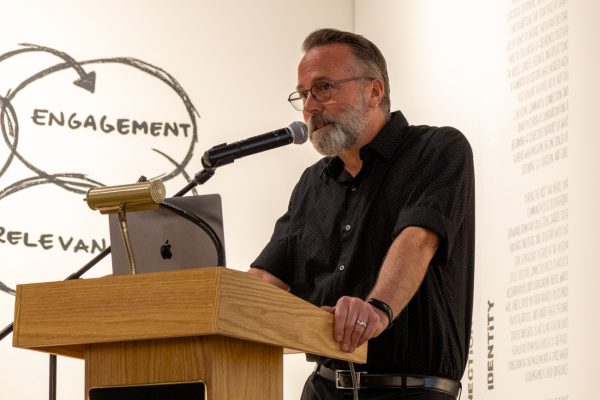
Ted Adler, professor of ceramic media, spoke about clay and how ceramics hold intention.
“Engagement is activation, a continuous exchange, something both designed and encountered,” he said. “It registers what I act upon it, absorbing and reflecting each division, it amplifies and reorients my intention, returning something I cannot fully anticipate.”
After the forming of a vessel, he said it begins to resemble a body, in shape and how it carries weight — in a way that feels lived rather than described.
“These vessels cannot be fully resolved into symbols,” he said. “They resist the conclusion, they remain present as things, counter rather than explain.
“What we see is simply the way we want to tell the story, wholeness and healing are not declared here.”
The marrying of analog and digital space
Tim Stone spoke about contemporary space, how it is experienced and how it lives between the physical and digital worlds.
“I want there to be evidence of those two worlds colliding, but also merging and marrying,” he said. “There’s this sort of liminal new space that is being discovered by all of us.”
He said he learned to paint through the screen, and feels as though he is the last of a generation of an analogue childhood and digital teenage and adulthood.
“It’s a combination of all that, the work became formatting and representing these digital blips and representing things in ways of how we see them both in person,” he said. “With my work specifically being definitive of that hybridization of physical and digital space and what’s happening to our spaces.”
He spoke about the importance of being aware of what’s happening in the world, and continuing to be curious.
The curated exhibit with works from each of the faculty will be on display until June 13.