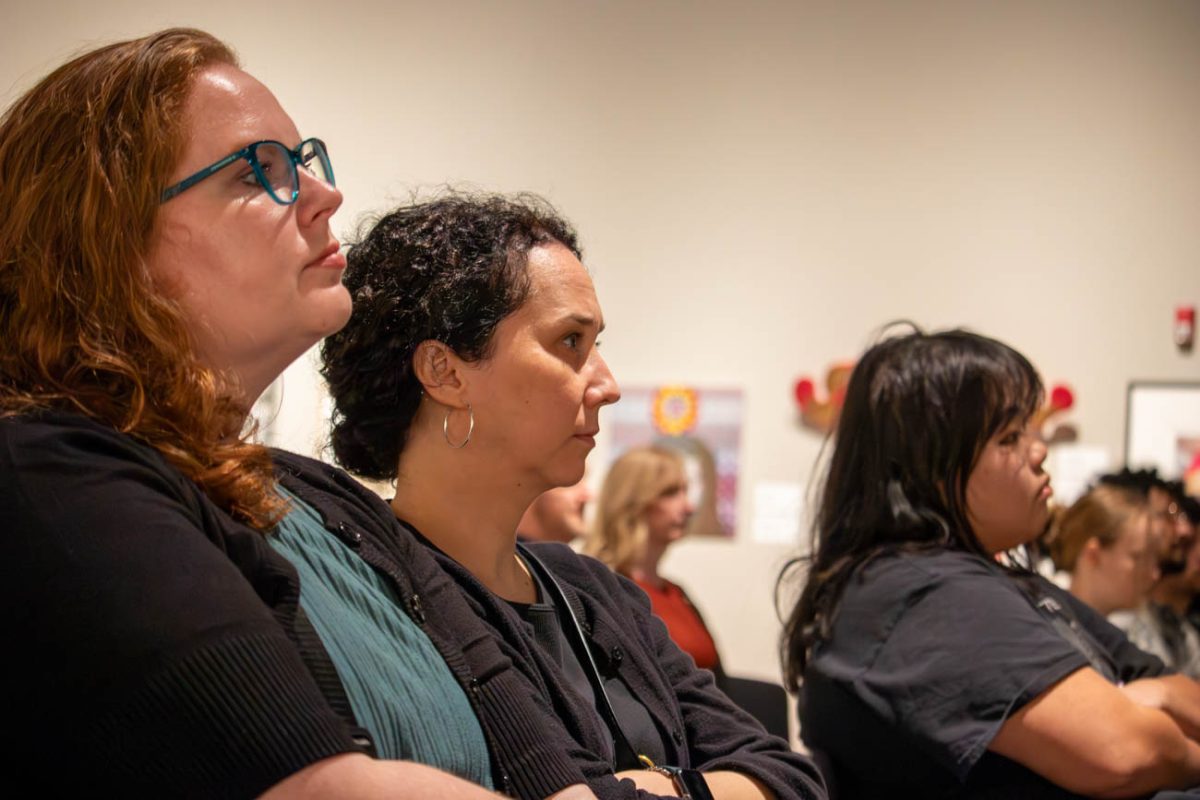
The Ulrich Museum of Art went quiet for exactly 20 seconds at a time Thursday evening — long enough to look, to sit with an image, to let it ask something of you.
That was the format: 20 images, 20 seconds each, six artists, one night.
The ADCI Faculty Artists’ “Symbols of Greatness” talk brought together six Wichita State University faculty to present work from the museum’s current exhibition.
Six very different artists — a printmaker, a graphic designer, an art historian, a studio painter, a horror-influenced multimedia artist and an instructor who brought a poem instead of slides — each had the same amount of time and the same exhibition prompt. What they did with it was anything but uniform.
Sprinting through history
Joshua Smith, an assistant professor of graphic design, opened with a word he invented: “truthoring.” Truth, authored.
His work examined a document once designed to function as a clean instructional signal that failed — not visually, but systemically. Rather than replace or add anything, he rearranged only what was already there, testing what meaning could shift through structure alone. His final slide landed quietly. Something was missing from the work, he said.
Six letters spelling out — SANITY.
Irma Puškarević, an assistant professor of graphic design, spent her slides on a history most people have never heard — women in 20th-century printing whose labor kept entire resistance operations running but who were written out of the official record. Her ongoing project, the “Woman Factor Archive,” is a handmade box of reimagined periodicals recovering that history one issue at a time.
The centerpiece of her talk was a specific Slavian typeface designed by a woman — proposed, drawn and then just left there, never made real. Puškarević actualized it herself because for her, the project isn’t about looking back at a finished history, but about “sitting inside an unfinished one” to challenge who still gets credited for the labor that sustains the structure of design today.
“That is not a historical question,” she said as her final slide faded. “It is today’s question.”
Break in the slides
The urgency shifted when Kendra Cremin, an ADCI instructor, walked up to the microphone and announced she was doing something different — a poem. She read Lawrence Ferlinghetti’s 1958 poem “I Am Waiting,” letting his long, restless catalog of American longing fill the room.
She chose him, she said, because he gave her language for her own discomfort with powerlessness inside larger systems. Cremin said he was a philosophical anarchist who believed art belonged to everyone, not just the educated few.
The room listened.
Brittany Lockard, an associate professor of art history, opened by asking the audience to say a word out loud.
The word was “fat.” She uses it herself as a plain description, same as noting she has gray hair or wears glasses. Her work traces how bodies get coded in art history, criticism, fiction and advertising to signal worth, intelligence and moral standing — from Renaissance sculpture to the “Jack Reacher” novels — and what it means when real people can’t measure up to images that were never meant to be real in the first place.
For Briella Lujan, a junior art education major in the audience, moments like that were the whole point of being there.
“I really liked being able to hear from my professors from the perspective of artists,” Lujan said. “Not just them telling me about art training, as a professor. I thought that was really beneficial.”
What the format couldn’t finish
After the talk ended, the room returned to life. People lingered, talked and pointed at the work on the walls with a new context for it. The artists who had just sprinted through six minutes and 40 seconds were now standing among the people they had been speaking to — unhurried, answering questions, continuing conversations the timer had cut short.
“I could have given a whole hour-long talk on Freddy Krueger,” said Megan St. Clair, a lecturer in studio arts, laughing after the event. “It was really hard to knit it all together.”
She wasn’t alone. Marie Bukowski, dean of the College of Fine Arts, said the format barely touched what she wanted to say.
“I’m a very process-driven person, and that drives everything I do, whether it’s my artwork or my job here,” she said. “I can spend all the livelong day talking about process.”
Lockard had similar feelings.
“I’m a teacher. I could do a whole class,” she said.
She added that she was moved by Cremin’s poetry presentation — the emotion of it, the way it stretched what a faculty talk could even look like.
The format also left attendees like Lujan wanting more time with the images.
“There were a lot of pieces that were really intriguing,” she said. “I would have loved to be able to engage with them more.”
Bukowski called her colleagues “rock stars.”
What struck her most, she said, was the range — how differently each discipline approached the same stubborn question of who gets to author history and who gets written out of it.
These six faculty members have a different answer. It’s on the walls at Polk-Wilson. Thursday night, you could feel it in the room too.
“Symbols of Greatness: Restoring Truth and Sanity to American History” is on view at the Ulrich Museum of Art on campus until June 13.