About this time last year, we, as a student body, welcomed the current Student Government President Jia Wen Wang and Vice President Amy Nguyen as our new student government leaders. They ran uncontested and have served a respectable and dignified term.
The lack of student participation in the Student Government Association has been noticeable throughout recent academic years, but we are fortunate to see a contested presidential election this year. However, I will say that the announcement of election candidates left me with a singular emotion paramount.
Which is to say — I was confused.
The dual tickets feature Student Senators Mason Fouquet and Nazanin Kasirosafar opposite Undergraduate Advocate Jayden Island and SGA Director of Health and Wellness Anoushka Raju. Fouquet and Island are running for president on their respective tickets.
My first thought was: “Fouquet? Didn’t he just join?”
Indeed, he did. Fouquet is a recent addition to WSU’s student government; he entered SGA mid-semester last fall as a write-in primary candidate.
Now, term length isn’t everything when it comes to a qualified candidate, but it is a little concerning when it comes to running for the highest position within SGA. This is further supported by the fact that his running mate, Kasirosafar, has also served less than a year, meaning she would not have a significant margin of experience to supplement the knowledge Fouquet may lack.
I think this is put in sharp contrast by their opposing ticket. Island is a student advocate in the legislative branch and previously served in the Senate. Raju is part of the executive cabinet. Raju has served a comparable tenure to Kasirosafar, while Island is in their second year in SGA.
Why does this matter? I think this is made clear by the level of professionalism each ticket has shown in their campaigns.
Browsing the Instagram profiles for either ticket, I was impressed immediately with the organization of Island and Raju’s platform. Their campaign had a distinct color palette and style. Furthermore, their page is consistent, down to the music choice for each post, which struck me as very fitting to their campaign image while being recognizable as more than just a default media-safe aesthetic.
Sue me, marketing is unfortunately what makes up a good chunk of communication studies. The campaign features an abundance of unique, personal testimonies from a number of students about why they support the two, which I thought was a very adept way to show commitment to engagement and community.
This is not to say Fouquet and Kasirosafar lack a good social media presence. They also feature an organized aesthetic with prompt updates on election-related news. However, unlike Island and Raju, I do think Fouquet and Kasirosafar’s media strikes such a similarity to official WSU design that it does not grant them the same memorability as Island and Raju.
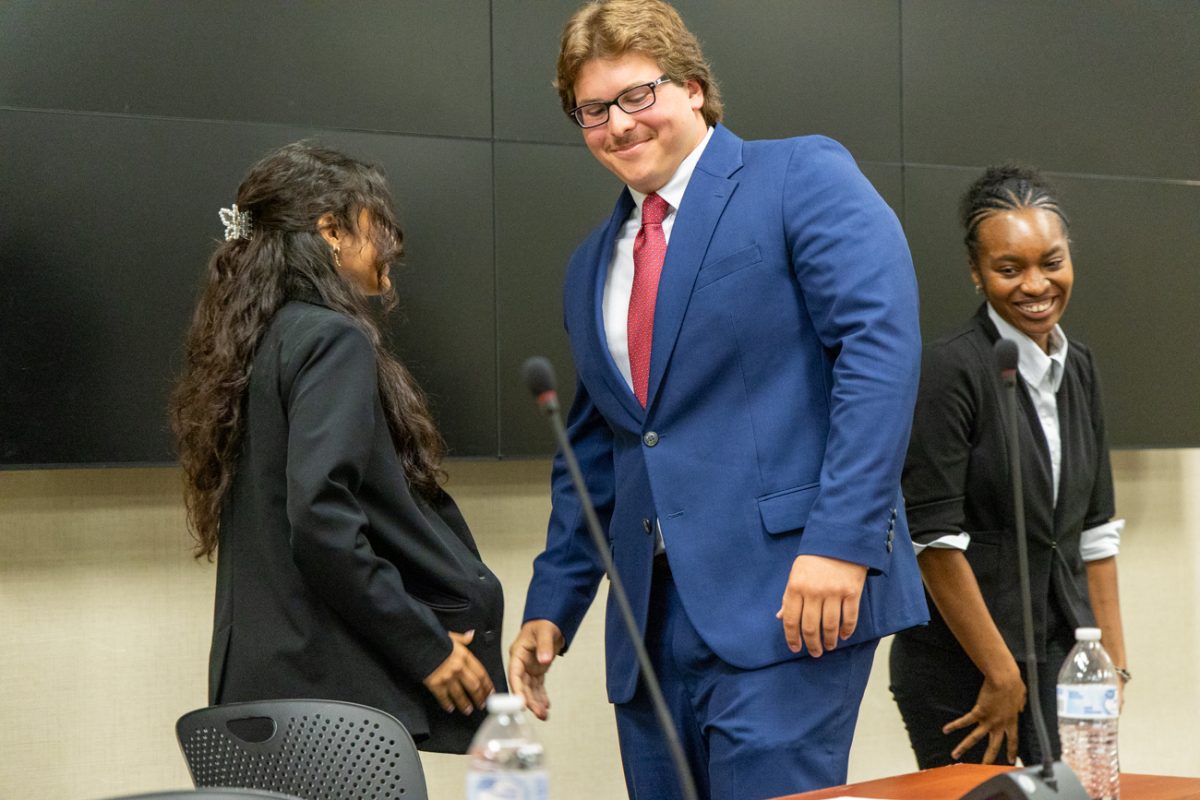
Outside of media presence, I think we can also see a difference in professionalism in each ticket’s showing in the presidential debates on March 26 and April 2.
I work late, so my roommate viewed the March 26 debate before I did. When I asked her what she thought of each ticket, she told me that while both tickets expressed similar sentiments, she believed that Island and Raju were able to answer with less vagueness and better clarity. I agreed.
I found that all four candidates were skillful speakers and made good points across the board. The particular eloquence of Island and Raju definitely set the expectation for response quality high. Island stands out to me as a speaker, and it really seemed like they created a strong platform.
The second debate took a bit of a different tone than the first, having picked up the pace with more questions submitted by students. Once again, I was impressed by Island and Raju’s ability to answer concisely and articulately in the short time allowed. Fouquet attended the second debate alone, as Kasirosafar was out of the country, but followed along online.
I don’t know if it was the lack of his running mate throwing him off, but Fouquet did seem less polished on the second debate.
Notably, when discussing the unique outreach approach he would take if elected, Fouquet offered a suggestion for a group chat of student organization leaders, which is already in place. After an acknowledgment of his memory slip, he recommended that the SGA executive branch perform tabling to reach students. Island rebutted with a reminder that SGA leadership already does that as well, with themself and Raju having attended an estimated 80% of those tabling sessions this year. This estimation comes from Island themself, which I am unable to confirm.
The question specifically asked for ideas that weren’t already in place.
Also, when answering a question about how each ticket would support students of color and queer students in the wake of state policy changes, Fouquet, the vice president of WSU’s Turning Point USA chapter, stated that the question felt almost pointed. He said he didn’t believe that certain groups should be “cherry picked” for support — that all students should receive equal support. He also emphasized the importance of compliance with state law.
Island replied that their administration would seek creative solutions to ensure safe spaces for marginalized students while maintaining administrative accountability. Raju added that equality isn’t the same as equity — not all students have access to the same resources, so they may need additional, targeted support to be successful.
In response, Fouquet pointed out that Island had mentioned that “the university might not be set up as well for Black students.” He then asked Island, who is Black, to elaborate on that.
I feel this comment is much more pointed than the very pertinent and widely-discussed starting question. While the second debate did see both tickets referencing possible shortcomings of the opposing ticket — making it a more personal discussion than the previous — this seems like a breach in professionalism that is at odds with the rest of the debate.
I feel like Fouquet’s performance in the second debate, alongside his and Kasirosafar’s less collected showing in general, does not build the sort of confidence I expect in the highest tier of my community leaders. Fouquet and Kasirosafar are assets to their community by their service in SGA and beyond, but I do not believe them to be the best equipped for the roles of president and vice president.
More than anything else, I recommend that anyone reading this article should devote time to looking up each ticket’s campaign media, including their Instagram accounts, as well as watching the March 26 debate and the April 2 debate. Take what I’ve said with a grain of salt and let the candidates themselves convince you.
And of course, don’t forget to mark the date — general elections are open April 6-8 via SimplyVoting. You’ll get a notice sent to your student email. I hope all of you vote consciously and enthusiastically.