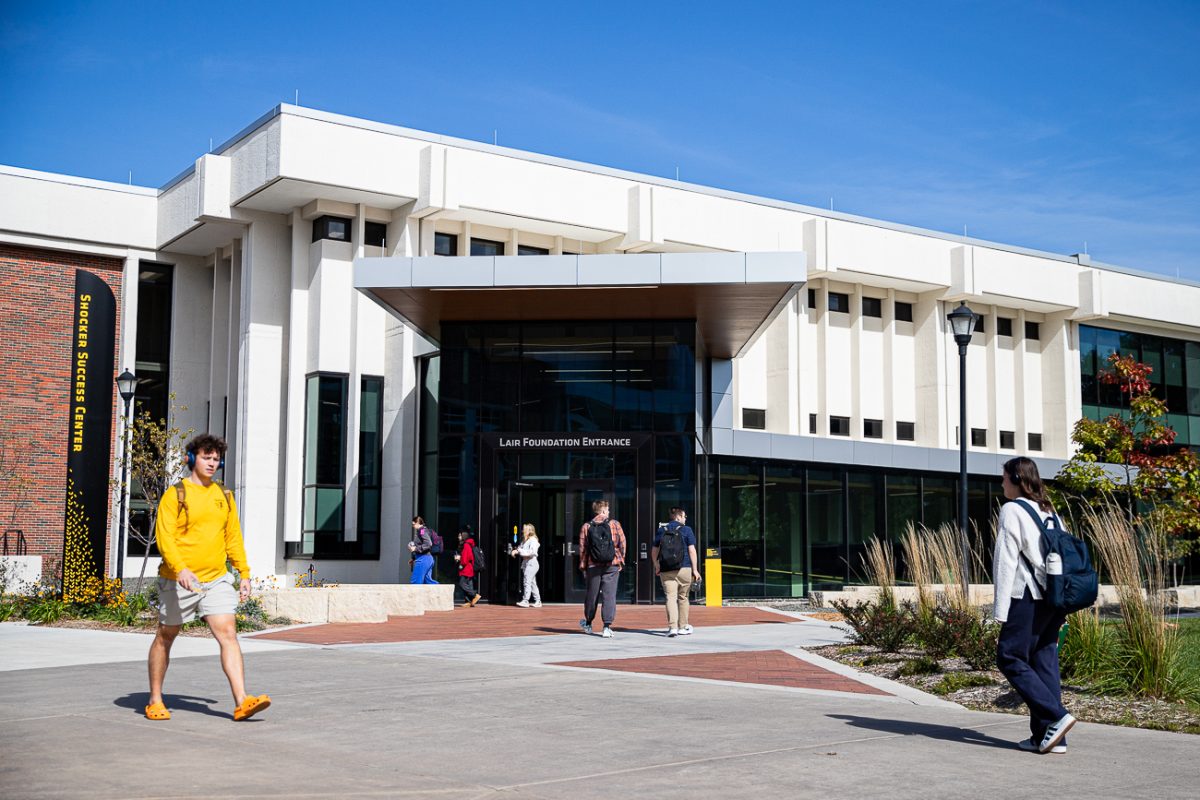
Sarah Mathews, the director of the Shocker Career Accelerator, said the market for spring 2026 graduates is “more competitive than ever.”
“People who have years of experience are transitioning into sometimes entry-level roles,” Mathews said. “So students who are graduating college aren’t just competing with other college graduates; they might be competing with more seasoned professionals.”
Another change that Aaron Evans, a career coach for the Shocker Career Accelerator, has noticed with this graduating class is the time it takes to get a job.
“Whereas when I first started, that first wave of students, maybe it was taking closer from five to six months to get a job, maybe now it’s taking closer to six to eight months to get a job,” Evans said. “If you’ve got a few internships or if you’ve already got some employer connections, it might take a little bit less time.”
In November, the National Association of Colleges and Employers’ 2026 Job Outlook predicted hiring would be “flat” for the class of 2026 graduates. An April update found a 5.6% upward trend in hiring, but the growth is uneven.
Employers in the outlook gave the job market a “fair” rating. The last time they gave this rating was for the class of 2021, when overall hiring projections were also flat.
But changes in the job market are largely dependent on the industry.
In engineering, Mathews has noticed a trend of employers wanting “earlier engagement” with prospective hires, like internship programs that often serve as pipelines to future employment. Fields with high demand, like healthcare and education, will often have a less competitive application process and have less need to utilize marketing tools like LinkedIn to secure employment, Mathews said.
Location also matters a lot to access certain industries.
“Students need to have an understanding: ‘Does the industry I want to work in match the location I want to be?’” Mathews said. “Because that will also give them an idea of, ‘OK, if there’s not a lot of opportunity in this location, it’s going to be really competitive. And I might have to do something that’s adjacent to what I want to do,’ or, ‘Am I open to moving location where there’s a thriving industry?’”
AI in the job market
Another shift in the market has come with artificial intelligence.
“There’s this battle because sometimes in education, AI can be seen as bad…” Mathews said. “But it’s so important that in the university setting, we’re teaching students the right way to use it because employers are going to start expecting their entry-level workers to be able to use it effectively and ethically.”
And NACE’s report has shown employers are gradually expecting more entry-level workers to understand how to use AI, with 35% of entry-level jobs requiring AI skills and 16.5% of entry-level job descriptions including AI skills. The use of AI skills is also heavily dependent on the industry.
“But AI can only do so much,” Mathews said. “You can have AI write your resume or feed you interview answers, but employers still crave the human, the humanity in people.
“Authenticity, I think, is going to continue to be really important in the next generation because things sometimes can lean more AI-focused.”
AI is shaping the application process on both the applicant side and in review. But on the applicant side, Evans sees it more as a supplementary tool.
“When you think about the ethics of it, it’s more for preparation processes and being organized,” he said.
How to stand out as an applicant
Having applied learning and work-based experience is “a real benefit and helps students be competitive in the market,” Mathews said.
But even if you haven’t participated in applied learning, Evans recommends leveraging your other experiences.
“We talk about applied learning and internships, and those are really more formalized experiences,” Evans said. “But your involvement, the things that you do within the community, the things that you’ve done in the university and your department, those are all still experiences that shape experience in some way.”
On the resume, a lot of that comes from the way applicants describe experience. Adding numbers to your description and quantifying the scope of your skills can help you stand out, Mathews said.
“An example is, ‘I lead students from my student organization,’” Mathews said. “Great. I can, as a hiring manager, see we’ve got some leadership skills, but leading three people and leading 25 people and leading 50 people is different.”
She said that students often overlook the basic skills — communication, teamwork, problem solving, curiosity and drive. Demonstrating those, Mathews said, can make the difference between two people who might otherwise look the same on paper.
“Students really need to customize their resume for every job they apply to, and that takes a lot more time, a lot more effort, and when you’re spending that much time and effort, it can be frustrating,” Matthews said. “But I do think students will see better results if they take the time to do that.”
Mathews recommends a balance between the quantity and quality of job applications.
“The students that don’t have anything figured out yet, we’ve really seen it takes at least six months,” Mathews said. “And it’s not just the applying, it’s the connecting and networking.
“So if you’re just spending all your time applying and you’re not spending any time going out and meeting people… we’ve got to build that in.”
But networking is more than just career fairs and business cards.
“These are connections that you all make in the classroom, you know, in your working experiences and your clubs and organizations,” Evans said.
LinkedIn offers a digital form of networking, which the Shocker Career Accelerator helps students adapt to. They offer a LinkedIn operation appointment, where a coach guides a student on how to build a profile and engage.
On top of making connections, Evans also recommended using the research tools on LinkedIn to get more information if you are trying to shift to a different market.
Alongside networking, effectively communicating your experience and your skills in the job application process is important.
“Where students have the most opportunity is when they get into the interview phase of applying for a job because now it’s about storytelling,” Mathews said.
Before you interview for a position, Evans recommends thinking about what experiences you’re most proud of and why.
“You’re selling your experience,” Evans said. “But you’re also talking about what kind of person you are, even in some cases, some adversity that you’ve overcome. And your experiences are a good way to do that.”
Persistence and grit
As the timeframe to get a job gets longer, determination is one of the most important factors in landing a position.
“Everybody’s journey is different,” Evans said. “And so, even if you’re feeling like you’re seeing opportunities that others are getting that maybe you’re not getting and you’re working equally hard, if not harder, it doesn’t mean you’re doing something wrong.”
Both Evans and Mathews agreed that sometimes the focus needs to be shifted more to the short-term than the long-term.
“I hope students realize that the first job doesn’t have to be the job,” Mathews said.
“With this generation… they’re very entrepreneurial. They want to do it all themselves.”
They also agreed that it’s still fine not to know exactly what your end goal is.
“It’s OK to be uncertain of the end goal fully,” Mathews said. “And also be open enough to realize that it’s OK to change that as we go through life and we evaluate our experiences and make decisions to move forward in the best way that we think will benefit our lives.”
But now, grit and perseverance mean more than anything.
“The tougher the journey may feel, the more rewarding it’ll be at the end,” Evans said.
The Shocker Career Accelerator offers all of its services to alumni, including career exploration, resume help and job search prep. Appointments can be made online through Shocker Central.