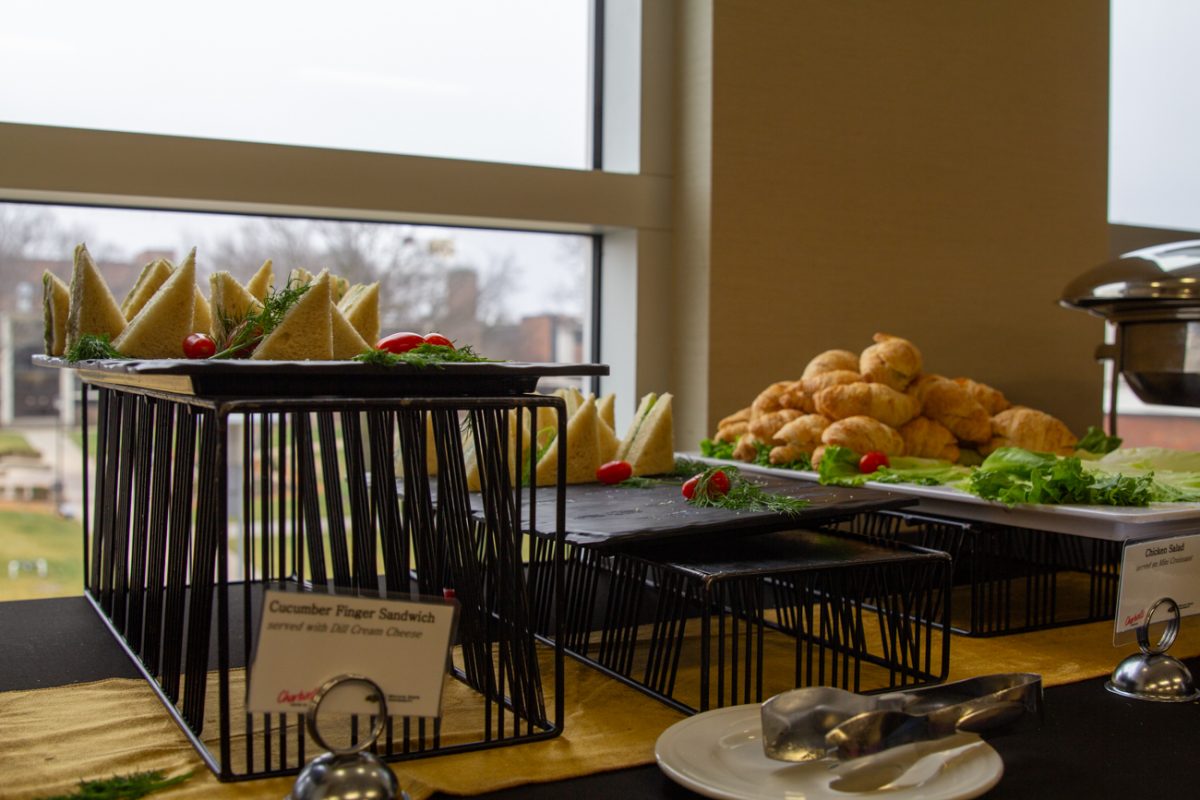
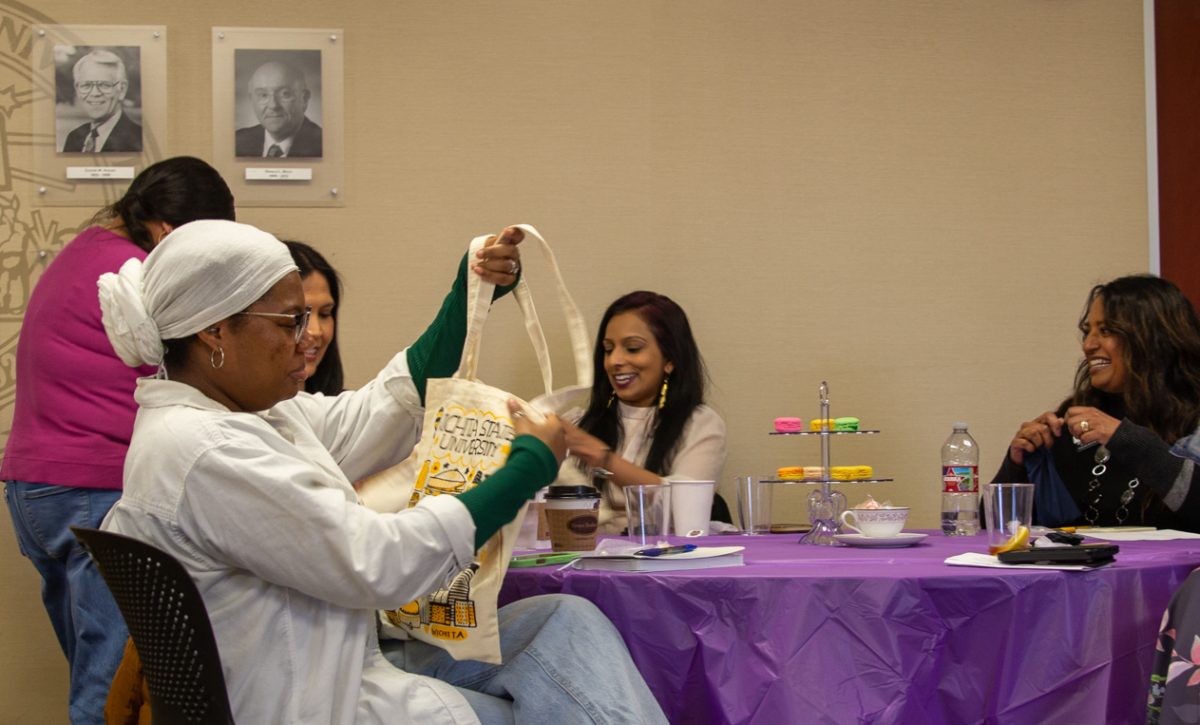
As guests entered the doors of a Women’s History Month panel at Wichita State, they grabbed food from a table filled with tea-party-style treats, including triangle-cut cucumber sandwiches, pastries and fruit skewers.
An intimate group of students and faculty sat at tables with pastel-colored tablecloths, each adorned with flowers, topped with a tower of macaroons and a party favor at each seat on Wednesday.
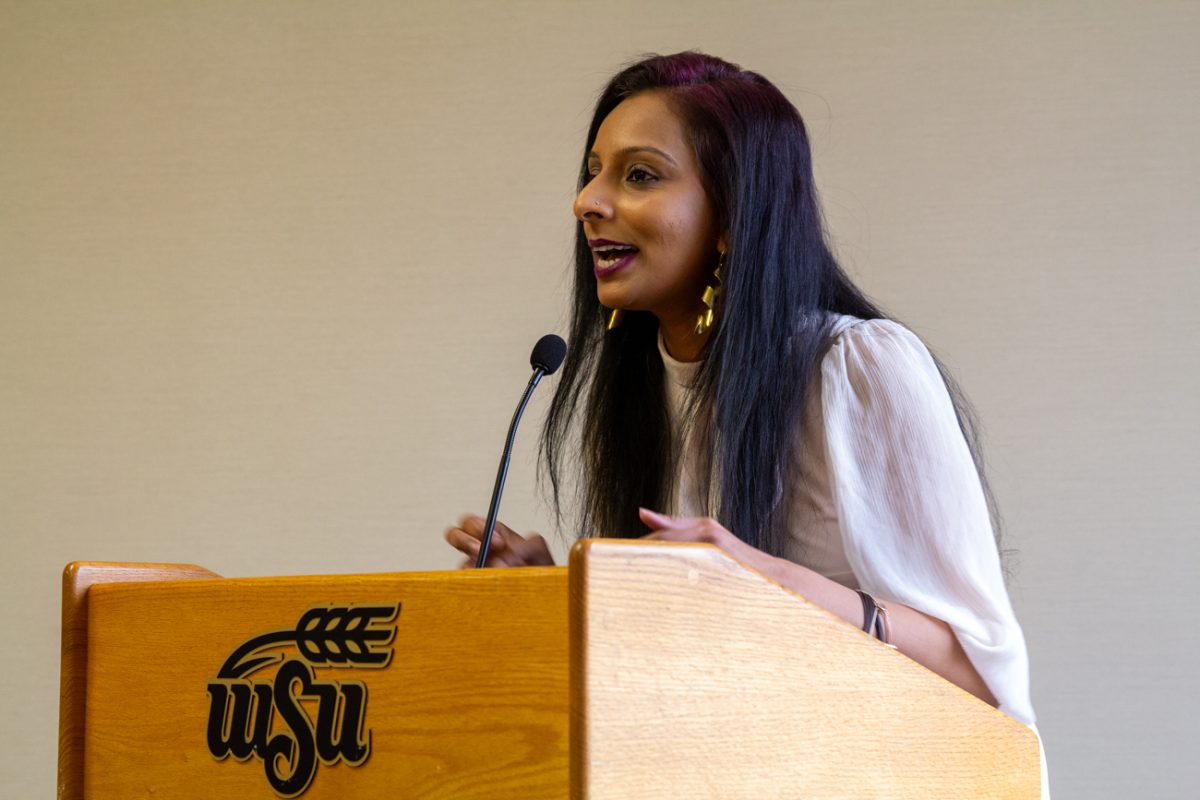
Candace Dave, a graduate assistant in Student Engagement and Belonging, organized the event, bringing “inspirational and powerful” women on campus together to share their stories with students and other guests.
“This month reminds us that women’s contributions are living, ongoing and deeply impactful,” Dave said before introducing the speakers. “We’re honored to be joined by remarkable women whose experiences and leadership enrich our campus and community.”
There were six different speakers, who each spoke about their relationship with femininity in the world of higher education.
The importance of female higher education
Sara Mata, executive director of Hispanic Speaking Initiatives, shared her journey to become a PhD holder, opening up about recent struggles as she’s taken the role of primary caretaker for her mother.
“I have been able to be here to support my mama, and she has ungraciously faced the brutality of aging and the illness,” Mata said, choking up. “Throughout all the educational, professional development, everything that we go through, there are no classes and no preparation for being a caregiver for your ailing parents.”
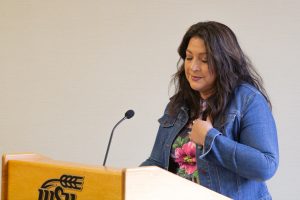
Mata recalled the hardships of getting her PdD, which she said could be “life-sucking” at times. She said she pushed through with the support of colleagues and friends to complete a degree that is held by few, especially among Latina women.
“As a Latina, with a PhD, I am proud,’ Mata said. “I am extremely proud to be one (of) less than 1% of Latinas to have earned a doctorate. I am passionate in promoting students to thrive in college and eventually receive a graduate degree.”
Mythili Menon, director and associate professor of linguistics, spoke about her unique experience growing up in Kerala, India, one of the few matrilineal communities in the country where inheritance is traced through the mother’s line.
“Any person I saw who had power was a woman,” Menon said. “My mom, my grandma, my great grandma — and they all had education. Education was a huge factor in my family growing up. If you are a girl, you had to be educated.”
She compared aspects of life in the state of Kerala and India as a whole. In India, female infanticide, the intentional, deliberate killing of newborn female infants, is “very high.” Menon attributed this to the gender inequality in the country, which is especially connected to dowry.
“A dowry is a huge sum of money… that has to be given to the boy’s family for taking care of your daughter,” Menon said. “And so it is actually illegal to find the gender of your baby in India because the female infanticide is so high.”
She said that Kerala is different in various aspects. It’s the only state in the country with a higher female-to-male ratio; the female literacy rate sits at 95%, with a lower maternal mortality rate.
“The lesson I was being imparted… was that you have to stand up on your own feet,” Menon said. “You have to be self-sufficient, right? Before you get married, before you start a family… that is one lesson I impart to my students.”
Female resilience
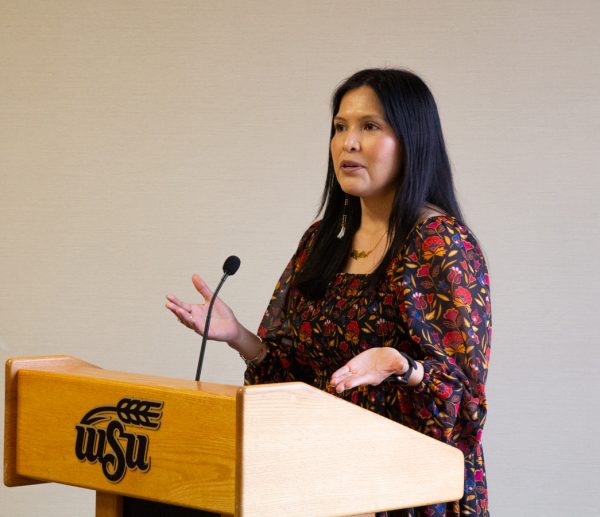
Chantal Nez Dominguez, a program manager with WSU’s Center for Public Health Initiatives, began the panel, introducing herself in the Navajo language.
“I introduced myself with my clans, and that’s a way to really honor the women,” Dominguez said. “Our tribe is a matrilineal tribe and culture, so we always pay respect to our paternal and our maternal grandmothers and mothers as well… we connect through kinship.”
Dominguez is Diné, from the Navajo Nation in Arizona. Her tribe, similar to the state of Kerala, India, is also matrilineal.
Her interest in public health started at a young age, growing up in a home without running water or electricity, with a diabetic mother and a father with high blood pressure.
“Them accessing health care was really, really hard and really difficult,” Dominguez said. “Then also the fact that there was no practitioners in our community and so the barriers of language… of having culturally appropriate and respectful healthcare, I saw that right away, I really think that that helped me and my path into public health now.”
She shared that her mother died last month, and recalled one of the lessons she told her: “beginnings do not limit your becoming.”
“She always just said, no matter where you came from, you can pave the path of where you get to go, where your children get to go,” Dominguez said.
Now, her husband and three children drive her further to advocate for health care rights and to push her two daughters to become resilient.
“Young women… Students who are in this institute, you belong here,” Dominguez said. “Don’t ever let anyone tell you differently, don’t let anyone make you feel small. Don’t let anyone ever silence your voice. Stand up for what you think is right.”
Sheelu Surender, the assistant vice provost for financial aid and scholarships, spoke to curbing what she called “ANTs” or automatic negative thoughts.
“It’s so hard to silence those ANTs, but that is what you have to work at day in and day out,” Surender said. “Because you have every ability to do what you are trying to achieve.”
Bri Bell, academic and retention coordinator in Student Engagement and Belonging, shared poetry from her “brutal honesty journal” during her presentation.
“‘You cannot be silenced, and you for sure cannot be contained,’’ Bell read from her poem, “The Gentle Soul,”
“‘So do it. Give in to the boiling chaos around you.’”
Building community
“If you want to go fast, go alone. If you want to go far, go together,” said Surender, quoting an African proverb she said she first read during a tour of the Bill and Melinda Gates Foundation.
Surender took that message to heart.
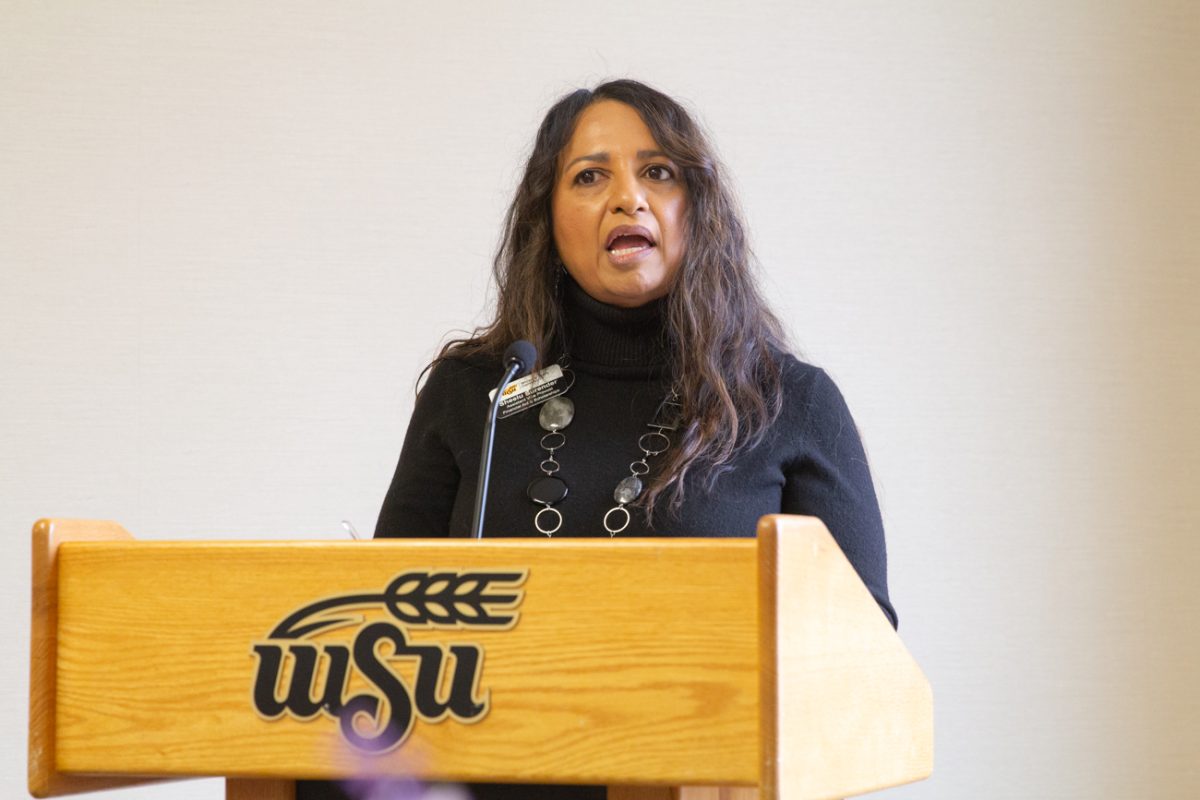
“Early in my career, I kind of misunderstood things about success,” Surender said. “I really thought it meant proving that I could do it all.”
She said one of the most important lessons she learned was that to go far, she had to rely on other people. She encouraged others to do the same.
“Go far, build community, share knowledge, ask for help, offer help and celebrate with one another,” Surender said, “Because when one woman rises alone, it’s inspiring. But when women rise together, it’s transformational.”
The final speaker, Christie Henderson, spoke about her love of higher education.
“I remember standing outside the Corbin Education Center, because I got my undergrad in education, and I said, ‘I’m going to work here someday,’ and I do,” Henderson said.
Henderson grew up in the foster care system and recalled the people who helped her along her journey, including her grandparents, who took her in.
“We all have an invisible paint bucket, and it’s not paint in our paint bucket,” Henderson said, recalling a story her grandfather told her when she was younger. “It’s the experiences and the stories and the mentors that we have that keep us going, that keep us painting.”
She ended with another lesson from her grandpa, Ken.
“(He) told me that it’s more important in life to build a legacy than a resume,” Henderson said. “And I’m really proud of my resume, but I hope that every one of you is proud of your legacy.”
After the event ended, Dave said she was happy with the way it went.
“It was very emotional,” Dave said. “I didn’t expect it to be so emotional in mood. I’m glad that it was, but it was just — their words were very moving… they gave a lot of great advice.”
Sony Thakuri, a master’s student in innovation and design, said the event was “inspirational.”
“I really got emotional hearing everyone’s story,” Thakuri said. “I also got a lot of motivation and inspiration, so many talked about building a legacy and giving back to the community.
“It was really beautiful just to be here in a room full of women, hearing their stories.”
Editor’s note: This story has been updated to correctly identify Chantal Nez Dominguez, a program manager with WSU’s Center for Public Health Initiatives.