


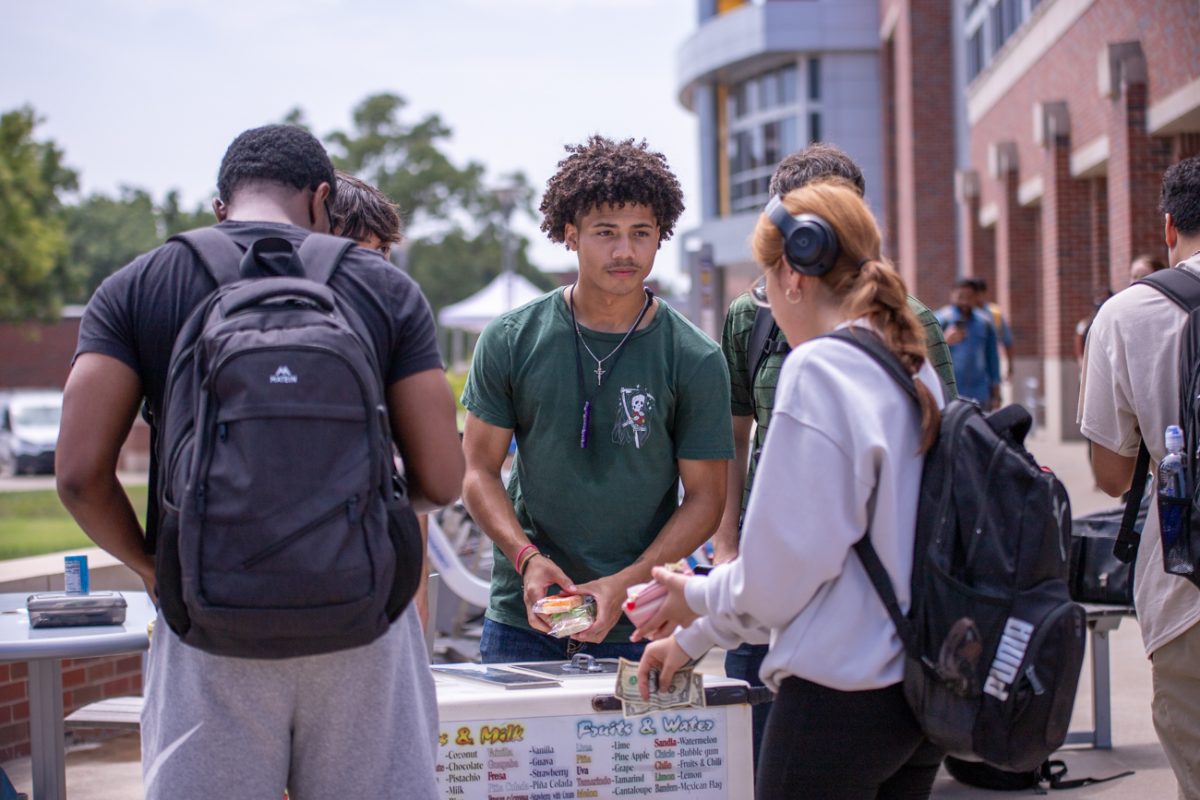
In a Wichita State University aerospace engineering classroom, the silence isn’t always about concentration. For Aoi Ito, an undergraduate student from Japan, it’s a cultural hangover.
Back home, a classroom is a place of quiet reception; here, it is a theatre of participation.
“In my country, there is a kind of pressure against offering (answers to) questions in class,” Aoi said. “But here, students want to answer them by themselves. It’s very interesting.”
For the 3,166 international students, recorded in the fall census, who study at WSU, the “academic struggle” isn’t just about mastering complex fluid mechanics or data structures. It is a constant, exhausting act of translation—not just of language, but of social unwritten rules, teaching styles, and the sheer pace of American higher education.
Language barriers make lectures extra challenging
While domestic students might complain about a professor’s handwriting, international students often face a more invisible hurdle: the verbal-only lecture.
Aoi noted that when professors forgo handouts or digital slides in favor of “just words,” the cognitive load doubles. Without a slide or a handout to look at, the language gap can feel much wider. Many international students bridge that gap by leaning on peer support to make sense of the “just words” lectures.
“This university has a lot of support,” Aoi said, pointing to teaching assistants as a vital lifeline for navigating the lectures that “just stay with the words.”
The speed and the rules
The transition is even more jarring for graduate students like Pratyusha Daram. Coming from Telangana, India, to pursue a Master’s in Data Science, Daram found that the American “practical” approach is a far cry from the theory-heavy teaching models back home.
But the biggest shock? The clock.
“For some people who just finished their undergraduation and come here for masters, they have to be really fast to learn things,” Daram said.
Beyond the pace lies the “unwritten rule” of American academic integrity. In many global education systems, collaboration is the default; at WSU, the line between “helping” and “plagiarism” can be a legalistic minefield that international students must learn to navigate on day one. Daram said that adapting to these unique assignment timelines and integrity standards is the “secret” to staying afloat.
Survival starts at the suitcase
Success, however, requires more than just academic skills; it requires a full stomach and a winter coat.
Cristina Castillo, a sophomore accounting major from Dallas, Texas, has observed that the international struggle often starts at the suitcase. Because students can’t pack their entire lives into two checked bags, campus resources like the Kiah Duggins Shocker Support Locker and the Career Closet become more than just amenities—they are essential infrastructure.
“A lot of international students can’t pack a whole lot of stuff— clothes, food,” Castillo said. “The Shocker Locker and the professional Career Closet help a lot.”
Castillo also noted a social “bubble” that she said tends to persist in introductory courses, where domestic and international students remain politely segregated. It isn’t until the junior and senior years, when the heat of high-level coursework forces collaboration, that the bubbles finally pop.
Making the campus yours
As Wichita State leans into its role as the state’s most diverse campus, a common thread in these student experiences is a shift from passive enrollment to active engagement: the resources are there, but you have to be the one to grab them.
For Castillo, her advice to international peers is equal parts common sense and Shocker pride: “Utilize every resource. I mean, you’re paying for it,” Castillo said. “I always like to explore every building… it’s almost like it’s mine, you know?”
Castillo thinks international students should try to branch out from places like the Office of International Education and actually explore the rest of campus. To her, feeling like you belong at WSU mostly comes down to just talking to people, even if it feels a little awkward at the start.
“People like me, or people who are just working around—we’re always happy to help,” Castillo said. “If you have any questions, just ask. If you just want to say hi, say hi. Everyone’s nice here.”
For the student body’s international contingent, “making it mine” is the ultimate academic assignment—one that requires a strong foundation, a bit of TA assistance, and the courage to finally speak up in a quiet room.
Editor’s note: The name of a student was misspelled in a previous version of this story. The story has been updated to correctly name Cristina Castillo.


bojack horseman • Mar 10, 2026 at 10:42 am
Why does a non-international student have more presence in the story than the two international students included? A quote from the people that run/work at or utilize different support systems (such as the Shocker Locker or Career Closet mentioned) would be more impactful in this story than what a non-international student’s experience with the struggles of international students are.