



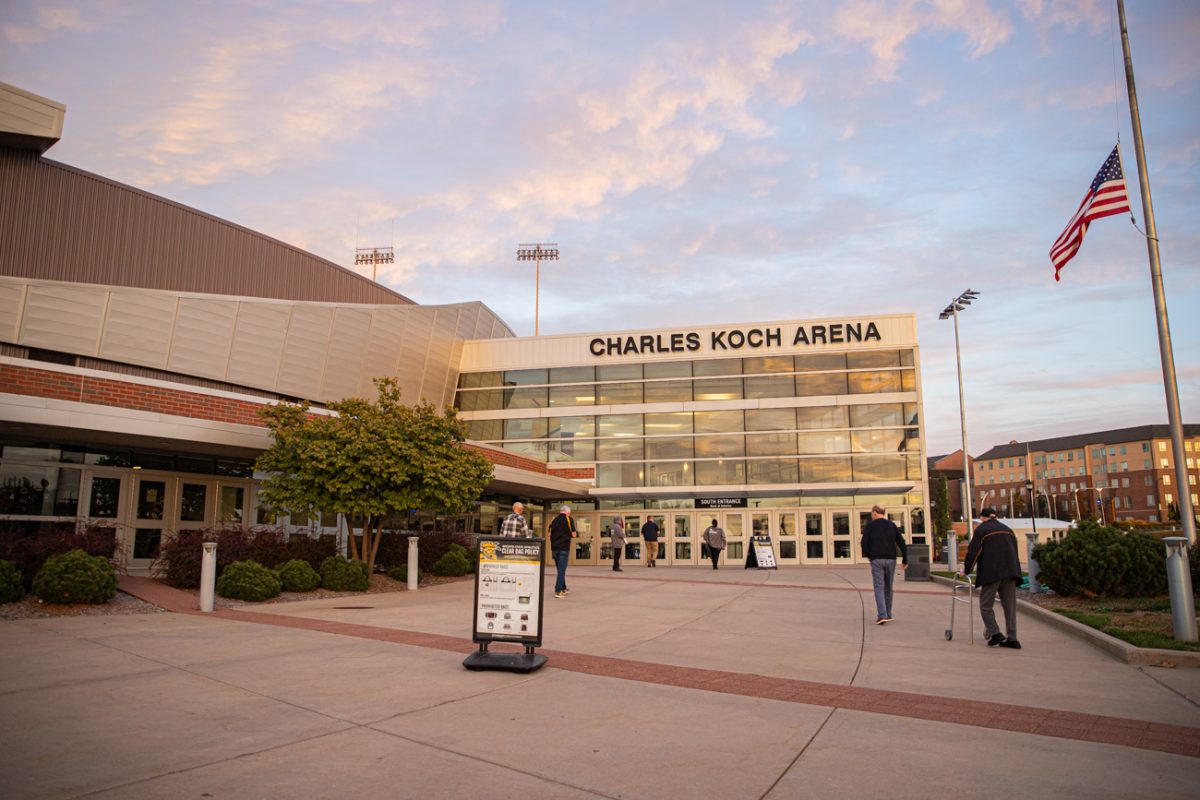
Paul Mills walked into Koch Arena’s media room on Tuesday in a grey suit and opened with a lighthearted joke that set the tone of how he sees the current landscape of college basketball — less corporate and more functional.
“Sometimes you have to dress like an adult for these meetings,” Mills said with a laugh. “We’re not bankers. We’re more like gym teachers. So we should probably dress more like gym teachers than bankers.”
Beyond the humor, Mills quickly turned to what he called the “final stage” of roster building through the transfer portal, emphasizing Wichita State’s roster retention as a key piece to their success next year.
The Shockers lost just two players to the portal this year: Dre Kindell and Brian Amuneke, departures that Mills said he understood. Despite them finding other opportunities, Wichita State will retain 43% of last season’s scoring production and minutes in its returning players.
Overall, Mills was pleased with the program’s continuity this offseason. Ten players will sport the black and yellow after the Shockers brought in 12 newcomers last year.
“Through this whole process, to lose two guys is a pretty high retention rate,” he said.
Core pieces of the roster remain intact, led by Wichita natives Henry Thengvall and TJ Williams, who Mills described as essential to the program.
Dillon Battie, Will Berg and Noah Hill also return as part of what Mills believes is a developing veteran group that helped fuel last season’s late momentum, including nine wins in the final 11 games, an American Conference championship game appearance and a run to the quarterfinals of the National Invitation Tournament.
“Those guys are trending upwards,” Mills said. “They still have a lot that’s untapped out of them.”
Wichita State has been widely projected near the top of the American Athletic Conference entering the season, Mills said, which he credited in part to the stability in the returning group.
Still, the Shockers were not shy in the portal, targeting specific skillsets to supplement the returning core.
The most notable additions were Jordan Frison and Jahari Long, two primary ball-handlers expected to elevate Wichita State’s heavy pick-and-roll offense. Frison arrives from Chattanooga after shooting at a 42% clip from 3-point range, while Long brings Power Five experience and strong analytical efficiency in ball-screen action.
Mills noted that the pairing was intentional.
“If you only have one playmaker on the court, they’re going to trap him,” he said. “We needed multiple guys who can create.”
The Shockers also brought in Dayton transfer Bryce Heard and New Mexico State center Cyr Malonga to round out the roster.
“There’s going to be a lot of work that’s involved in this,” Mills said.
“This isn’t add water and go play tomorrow,” he later added.
Mills also pointed to broader structural changes in college basketball, including NIL and transfer freedom, as drivers of how programs operate.
“This is the only sport … where there is unlimited free agency and no salary cap,” he said. “… A lot of people have to start over.”
Even with uncertainty across the sport, Mills said Wichita State is well-positioned because of support from the institution and community.
“We are not able to get players of that caliber if President (Rick) Muma is not on board, if (athletic director) Kevin Saal isn’t doing a lot of this heavy lifting,” he said.
Looking forward, Mills said the first real evaluation will come in November, with exhibition games serving as the first true test before the regular season.
“You get an idea for it in those exhibitions,” he said. “But you do not know until opening night.”
For now, Wichita State men’s basketball’s focus remains internal. Building chemistry, developing players, and maintaining continuity through retention are at the top of coach Mills’ list.
“I just walked out of this portal (cycle) really happy with where we landed,” he said.




Jeff • May 13, 2026 at 1:20 pm
And then there is no golf. If the Sunflower needs a summer project a deep drive into athletics business model would be a good one. Do we have any self sufficient sports? Do we have any sports that self support plus enough leftover to support a half dozen or so none revenue sporting teams? Is it time to reevaluate our conference relationship? Could we find universities that are feeling the same financial pressure within a reasonable geographical area to offset some cost? And then there is no golf so I see some of this is already answered. I’m not going to be happy about for awhile.